

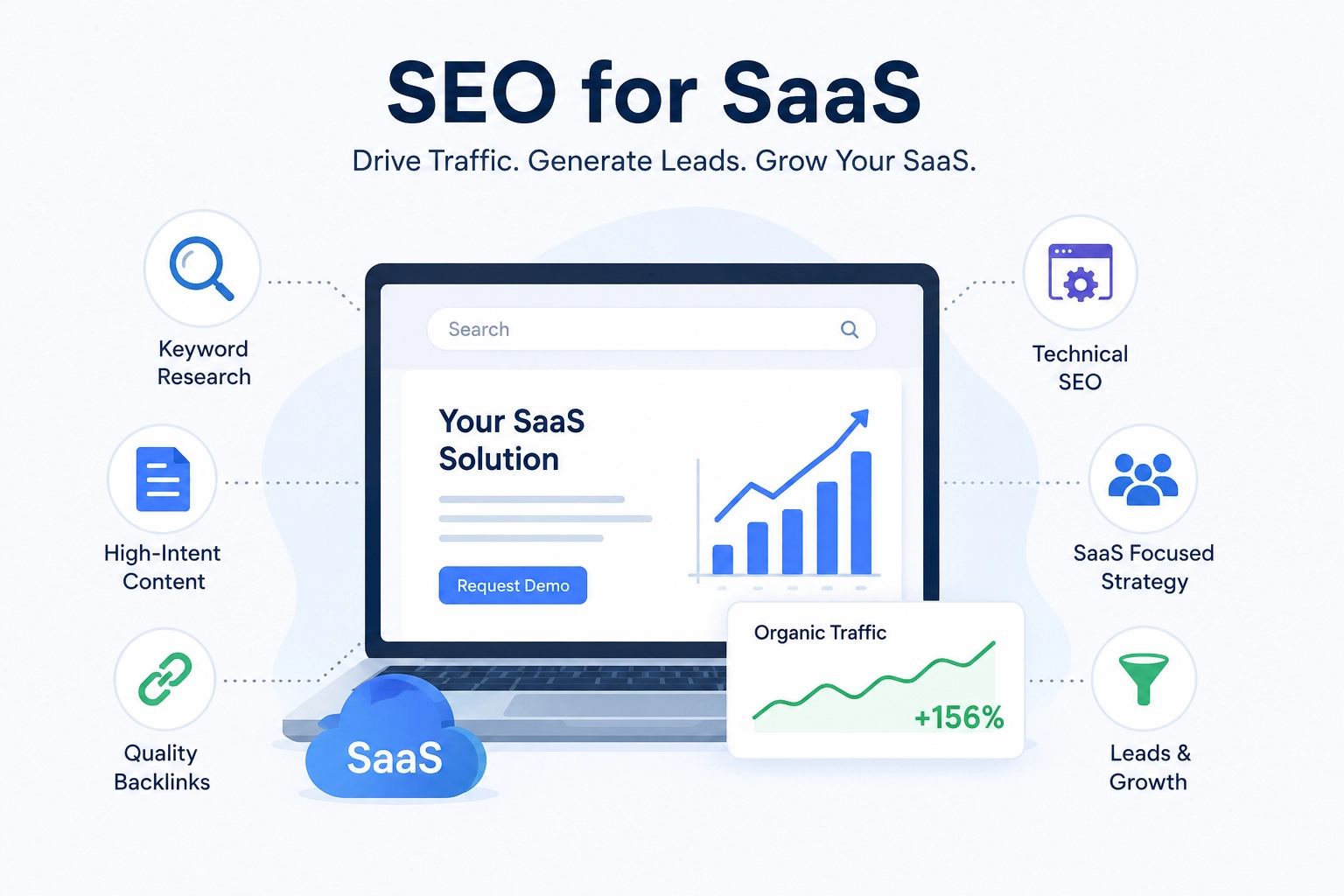
Because SaaS buying cycles often involve research, team review, vendor comparison, and budget approval, the strategy must cover more than blog traffic. It should connect awareness content, solution pages, feature pages, landing pages, and case studies into one clear path from search to evaluation.
At SSinvent, this framework is approached through technical analysis, content marketing, strategic backlinks, and web development to support qualified traffic and measurable organic growth.
Key Takeaways
- B2B SaaS SEO works best when it targets buyer intent, not just search volume.
- High-intent pages, such as comparison pages, solution pages, and feature pages, often yield higher-quality leads.
- Technical health, content, internal links, and backlinks need to work together.
- SaaS teams should measure organic traffic with conversions, demo requests, and pipeline data.
- A strong strategy needs clear keyword research, targeted keywords, product-led content, and ongoing technical review.
What Is B2B SaaS SEO?
B2B SaaS SEO is the process of improving a software company’s visibility in organic search for business buyers. It focuses on search engine optimization for pages that explain products, use cases, comparisons, integrations, pricing context, and educational topics. The goal is not only to attract visits, but to bring the right people to the right page at the right stage of their buying process.
This type of organic strategy differs from general search work because the buying cycle is often longer. A visitor may read several pages, compare tools, share options with a team, and request a demo later. That means the content needs to explain problems, show product fit, answer objections, and support decisions with clear information.
Why SEO for B2B SaaS Matters
Organic search can help SaaS businesses reach buyers before they speak with sales. A person may search for a problem, a feature, a software category, or a comparison between tools. When the right page appears for that query, the company can earn attention without relying only on paid campaigns.
For B2B SaaS companies, the value comes from connecting search intent to business intent. A page that attracts thousands of broad visitors may have less value than a page that brings a smaller group of decision-ready users. This is why the strategy must focus on relevance, buyer fit, and conversion paths.
Qualified Traffic and Pipeline
Qualified traffic comes from users who match the target audience and have a real reason to explore the product. These users may search for a workflow problem, a software alternative, or a specific feature they need. The page should help them understand the topic and see whether the SaaS product fits their situation.
Pipeline value connects search traffic with sales opportunities. A SaaS team should not judge performance only by rankings or sessions. It should also review how search users navigate the site, which pages drive conversions, and which topics support qualified opportunities.
Buyer Journey Alignment
The search strategy should match how SaaS buyers research, compare, and decide. A buyer may start with a general problem, move on to software options, compare vendors, and then seek proof before requesting a demo. Each stage needs a different page type because the user expects different information at each point.
At the awareness stage, blog posts and guides can explain problems, terms, and workflows. At the consideration stage, solution pages, comparison pages, and use case pages help users evaluate options. At the decision stage, landing pages, case studies, pricing context, demos, and trial pages support the final review.
Build a Search Strategy for SaaS Growth
A clear strategy gives the work direction. It defines the audience, the product value, the search opportunities, the technical issues, and the content plan. Without this structure, a team may publish many pages without building topical strength or attracting the right buyers.
Many SaaS strategies fail because they prioritize traffic over buyer intent. A page can rank and still bring visitors who have no need for the product. This creates reports that look positive, while demos, trials, and pipeline remain weak.
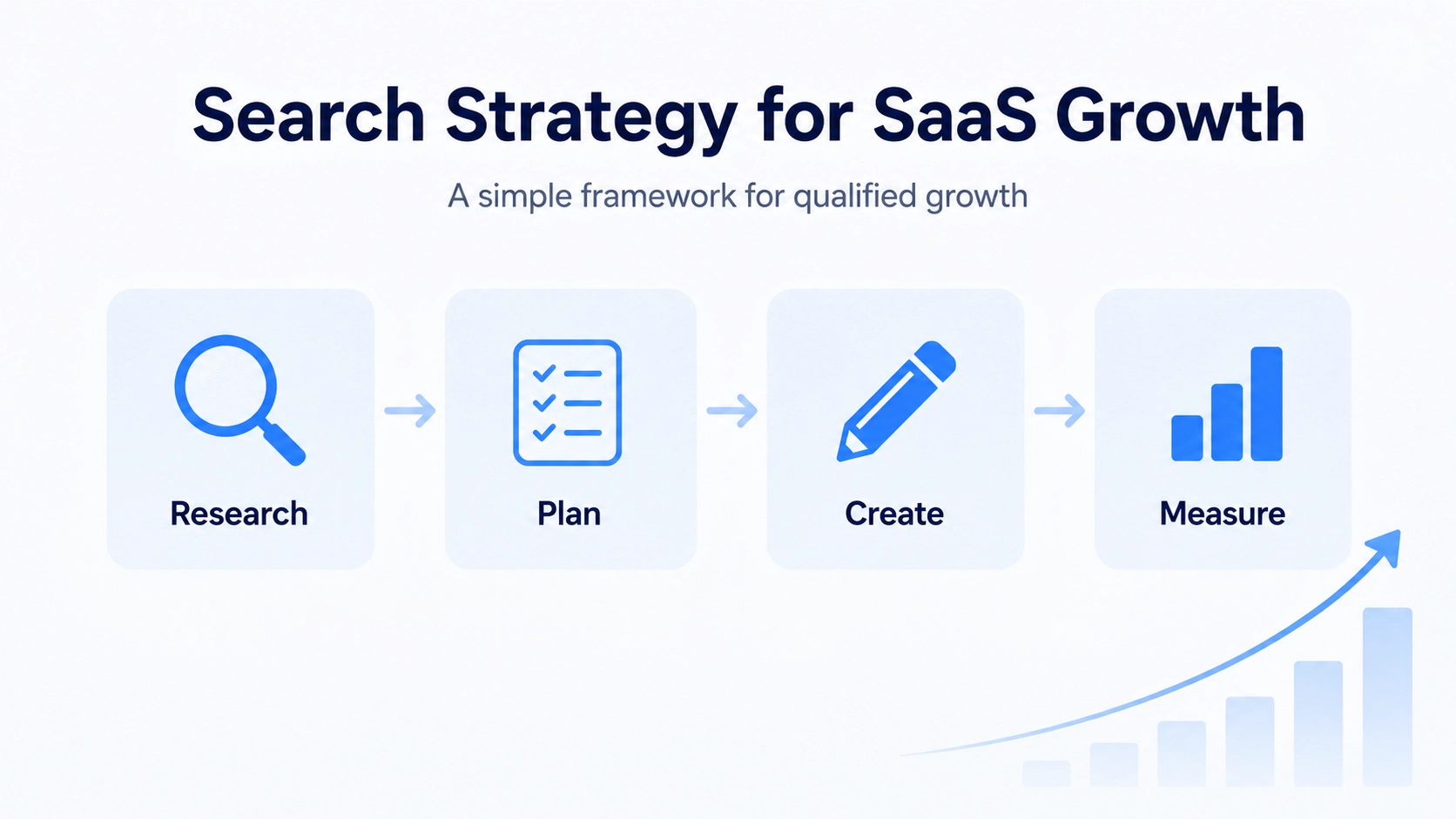
Audit Your Website
A website audit reviews how well the site can be crawled, indexed, read, and used. It should check technical issues, page structure, metadata, internal links, content quality, and conversion paths. The audit should also review whether important product pages are easy to find.
This step helps teams avoid building content on a weak foundation. If search engines cannot crawl key pages, new articles may have limited impact. If users cannot move from content to product pages, rankings may not translate into leads.
Map Buyer Intent
Buyer intent shows why someone searches and what they expect next. A user searching “what is workflow automation” may need education, while a user searching “best workflow automation software for agencies” may be closer to evaluation. Each intent type needs a different page format.
Mapping intent helps organize content by stage. Awareness content explains problems and concepts. Consideration content compares options, and decision content supports product evaluation.
Prioritize High-Intent Keywords
High-intent keywords show a stronger link between search and buying action. These terms may include words like software, platform, tool, alternative, comparison, pricing, integration, or use case. They often bring fewer searches than broad terms, but they can attract more useful visitors.
A dedicated page makes sense when the keyword has a clear intent that deserves a focused answer. For example, a term like “CRM for law firms” should not be buried inside a broad CRM guide. The user expects a page that speaks directly to law firms, their workflows, and their decision criteria.
Create Product-Led Content
Product-led content explains a topic while showing how a product can solve a related problem. It should not read like a sales page. It should teach the reader first, then explain where the product fits when that context helps.
For example, an article about customer onboarding metrics can explain key metrics, common problems, and review steps. It can then show how onboarding software tracks or improves those metrics. This approach connects education with product relevance.
Choose Keywords That Drive Leads
Keyword research should focus on what the buyer wants to solve, compare, or decide. It should not stop at search volume because volume alone does not show business value. A strong keyword plan weighs relevance, difficulty, intent, and connection to the product.
The best keyword sets often include a mix of informational, commercial, and decision-stage terms. Informational terms can educate the market. Commercial terms can capture users who already know they need a solution.
Sample Keyword Map
A keyword map connects search terms to the right page type. This helps avoid keyword overlap, thin content, and pages that compete with each other. It also gives each keyword a clear role in the buyer journey.
Bottom-Funnel and Comparison Terms
Bottom-funnel terms show that a user may be close to action. These queries often include phrases such as best software, alternatives, pricing, demo, platform, or solution. They can support landing pages, comparison pages, and product-focused guides.
Comparison terms help users choose between options. A strong comparison page should explain features, use cases, limits, pricing factors, and buyer fit. It should avoid unsupported claims and focus on balanced information.
Use Case and Jobs-to-Be-Done Terms
Use case terms describe a specific job that the software helps complete. Examples may include project management for agencies, CRM for startups, or reporting software for marketing teams. These searches often connect strongly with product value because they reflect real workflows.
Jobs-to-be-done topics focus on what the buyer wants to accomplish. A user may search for how to reduce churn, track onboarding, or manage client approvals. These topics help SaaS teams reach buyers earlier in the decision process.
Optimize Pages and Content
Page optimization turns research into pages that users and search engines can understand. Each page should have one clear purpose, one primary topic, and a logical path to related content. The structure should make it easy to identify who the page is for and what question it answers.
Good optimization includes headings, metadata, internal links, content depth, readability, and conversion points. The goal is to make the page useful without adding unnecessary sections. Strong pages answer the query, explain the topic, and help the reader decide what to do next.
Homepage, Feature, and Solution Pages
The homepage should explain the product category, audience, unique selling proposition, core value, and next steps. It should also link to important product, industry, and solution pages. Search engines and users both need a clear picture of what the company offers.
Feature pages should go deeper into specific product functions. Solution pages should target a clear audience, problem, industry, or workflow. These pages should address pain points, common tasks, decision factors, and, when helpful, links to related case studies.
Blog Posts and Internal Links
Blog posts should educate users and support the broader content strategy. SaaS content should avoid generic advice that any company could publish. It should connect the topic to the audience, product category, and search intent.
Internal links help users and crawlers move through related content. A strong internal linking plan connects blog posts, feature pages, solution pages, comparison pages, and conversion pages. Clear anchor text helps the reader understand what the next page will be before clicking.
Improve Technical Health and UX
Technical health affects how search engines discover and understand a SaaS website. It also affects how users experience the site once they arrive. A page with strong content can still struggle if it loads slowly, blocks crawlers, or creates confusion.
User experience and technical quality work together. Fast pages, clear navigation, accessible design, and clean site architecture help both people and search engines. These factors also support higher conversion rates by enabling users to navigate the site with less friction.
Site Speed and Indexing
Site speed affects crawlability, user experience, and engagement. Slow pages can cause users to leave before they read the content or fill out a form. SaaS websites often need extra care because scripts, product visuals, and tracking tools can slow pages down.
Indexing controls whether search engines can store and show pages in results. Google Search Console helps identify coverage issues, crawl problems, and excluded URLs. This data helps teams decide what to fix, consolidate, or remove.
JavaScript Rendering and Canonical Tags
Many SaaS sites use JavaScript frameworks for product pages, dashboards, animations, and interactive components. A technical review should confirm that important text, links, metadata, and navigation are visible to crawlers. If key content loads too late or cannot be rendered, the page may perform poorly.
Canonical tags tell search engines which version of a page should be treated as the primary version. This matters when a site has similar URLs, filtered pages, tracking parameters, or duplicate content. A poor canonical setup can split ranking signals across multiple pages.
Build Authority With Backlinks
Backlinks help search engines understand that other websites trust or reference a page. For SaaS companies, links can support category pages, research content, comparison guides, and high-value resources. Link building should focus on relevance, quality, and editorial value.
A strong backlink plan should avoid shortcuts that create risk. Low-quality links, irrelevant placements, and automated outreach can hurt credibility. Better links come from useful content, real relationships, and topics that deserve to be referenced.
Guest Posts and Digital PR
Guest posts and article submissions can help build visibility when they appear on relevant industry websites. The content should offer useful insight for the host audience, not only serve as a link placement. The link should fit naturally inside the article and point to a page that helps the reader learn more.
Digital PR focuses on earning mentions through useful material. SaaS teams can create data reports, surveys, studies, or expert commentary that journalists and publishers may cite. This approach works best when the source is original and relevant.
Resource Mentions and Partner Links
Resource mentions come from pages that list tools, guides, statistics, templates, or educational sources. These links can be useful when the SaaS company has a page that deserves inclusion. Examples may include calculators, templates, benchmark reports, or clear educational guides.
Partner links, including relevant affiliate links, can come from integrations, marketplaces, agencies, affiliates, or business relationships. These links are often relevant because they connect to a real product or business use. Clear context makes the link more useful for both readers and crawlers.
SaaS Search Examples
Examples help turn strategy into a clearer process. They show how different page types can target different intents. They also help teams see why a single article cannot carry the full organic growth plan.
Case-style examples are not guarantees of performance, but they show how page type, intent, and product fit can connect. They also make the article more useful for readers who need to apply the framework. The goal is to show practical use, not to promise outcomes.
Feature Page Example
A feature page might target a keyword like “automated client reporting software.” The page should explain what the feature does, who uses it, and which workflow it supports. It should also include clear sections on use cases, integrations, setup, and related product pages.
This page should not read like a feature list only. It should explain why the feature matters and how it solves a specific problem. Screenshots, short examples, and FAQs can help users understand the product in context.
Comparison Page Example
A reporting SaaS may build a comparison page for a keyword like “Databox alternative.” The page should compare use cases, dashboard flexibility, integrations, reporting limits, and buyer fit. It should stay balanced and avoid unsupported claims.
This page needs a clear structure because the reader is evaluating options. Tables, bullet points, and plain explanations can improve readability. The page should support a decision without overstating the product’s fit.
Blog Cluster Example
A customer onboarding platform may build a blog cluster around onboarding metrics. The cluster can include articles on time-to-value, activation rate, churn signals, onboarding checklists, and customer success workflows. Each article can link to product pages that explain how the software supports those tasks.
This approach builds depth on a single topic. It also creates many entry points from search. Over time, the cluster can support product pages that relate to onboarding workflows.
Measure Organic Performance
Measurement should connect search activity to business outcomes. Rankings and traffic are useful, but they do not tell the full story. SaaS teams need to know whether search users read key pages, convert, and become qualified opportunities.
The reporting process should use more than one tool. Google Analytics can show user behavior and conversion events. Search Console can show queries, clicks, impressions, and page performance in search.
Organic Conversions
Organic conversions include actions that users take after arriving from a search. These actions may include demo requests, free trials, newsletter signups, pricing page visits, or contact form submissions. The right conversion depends on the SaaS business model.
Teams should track both direct and assisted conversions. A blog post may not create a demo request in the same session, but it may introduce the user to the brand. Attribution should account for longer buying cycles.
Demo Requests and Pipeline
Demo requests often show stronger sales intent than general signups. Pages that attract demo requests usually answer a specific business need. These may include comparison pages, solution pages, feature pages, and high-intent landing pages.
Pipeline and revenue reporting require CRM alignment, clean tracking, and clear source data. A SaaS company should review which keywords and pages support qualified opportunities. This helps decide where to update, expand, consolidate content, or run search performance tests.
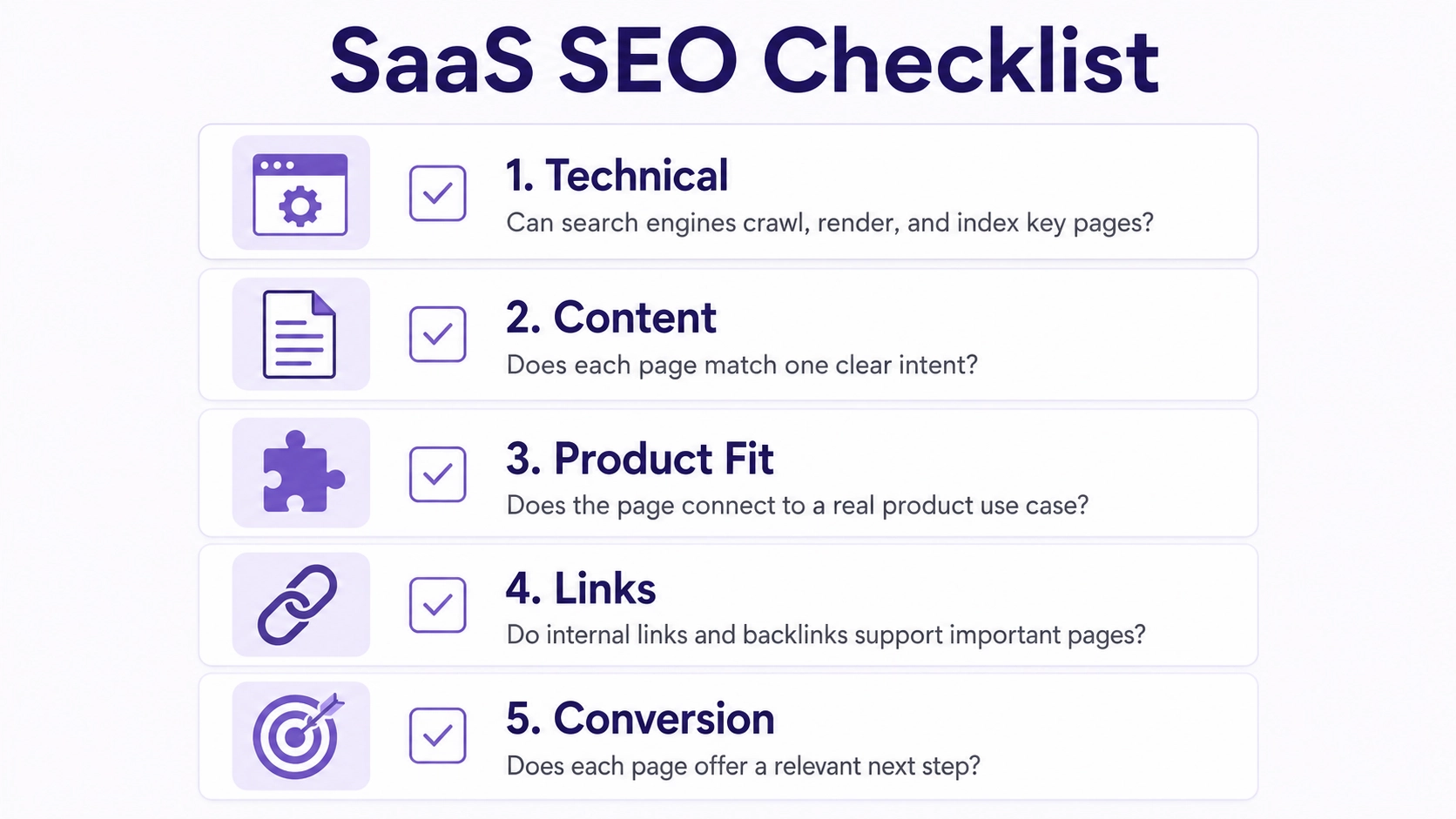
SaaS SEO Checklist
A checklist helps teams review the main parts of the strategy without losing direction. It should not replace analysis, but it can guide execution. The best checklist connects technical health, content quality, links, and conversion tracking.
Use the checklist as a working tool:
- Technical: Can search engines crawl, render, and index key pages?
- Content: Does each page match one clear intent?
- Product Fit: Does the page connect to a real product use case?
- Links: Do internal links and backlinks support important pages?
- Conversion: Does each page offer a relevant next step?
B2B SaaS SEO Services
SaaS-focused search services can include technical analysis, content planning, content production, link acquisition, and development support. The exact scope depends on the site, product, audience, and existing resources. A company should understand what each service covers before comparing providers.
A useful service plan should connect work to search intent and business goals. It should not focus only on publishing volume or ranking reports. The best structure explains what gets audited, what gets built, what gets measured, and how decisions are made.
Website Audit and UX Review
A website audit finds technical, content, and usability issues that may limit organic performance. It can review crawl paths, indexation, templates, metadata, page speed, internal links, and conversion paths. A UX review provides context by assessing whether users can easily understand and use the site.
This review should lead to prioritized recommendations. Not every issue has the same value. Teams should fix the problems that affect visibility, usability, and conversion paths first.
Content, Backlinks, and Development Support
Content marketing for SaaS should connect search demand with product relevance. It may include product-led articles, solution pages, comparison pages, integration pages, and topic clusters. Each content type should serve a clear purpose in the buyer journey.
Strategic backlinks support authority when they come from relevant and credible sources. Web development support helps turn organic recommendations into live improvements. This can include template changes, speed fixes, schema updates, internal link modules, navigation changes, and rendering improvements.
B2B SaaS SEO Agency or Consultant?
A company may consider an agency, a consultant, an in-house hire, or a mixed team. The right choice depends on budget, speed, technical needs, content capacity, and internal knowledge. Each option has strengths and limitations.
This decision should start with the problem. A company with many technical issues may need development and technical expertise. A company with weak content may need strategy, writing, and editorial support.
Agency Fit
A B2B SaaS SEO agency can make sense when a company needs several services at the same time. This may include audits, content strategy, writing, link building, analytics, and coordination of web development. Agencies often support broader execution by having multiple roles within a single team.
This fit works best when the company has clear goals and internal ownership. The agency needs product knowledge, access to data, and feedback from sales or customer teams. Without that input, the work may become too generic.
Consultant Fit
A B2B SaaS SEO consultant can fit when a company needs strategy, direction, or review more than full execution. Consultants often help with audits, roadmaps, content plans, technical recommendations, and team training. This option can work well when the company already has writers, developers, and marketers in place.
The limit is capacity. A consultant may identify what to do, but the company must have people to carry out the plan. The best fit depends on whether the main gap is strategy or execution.
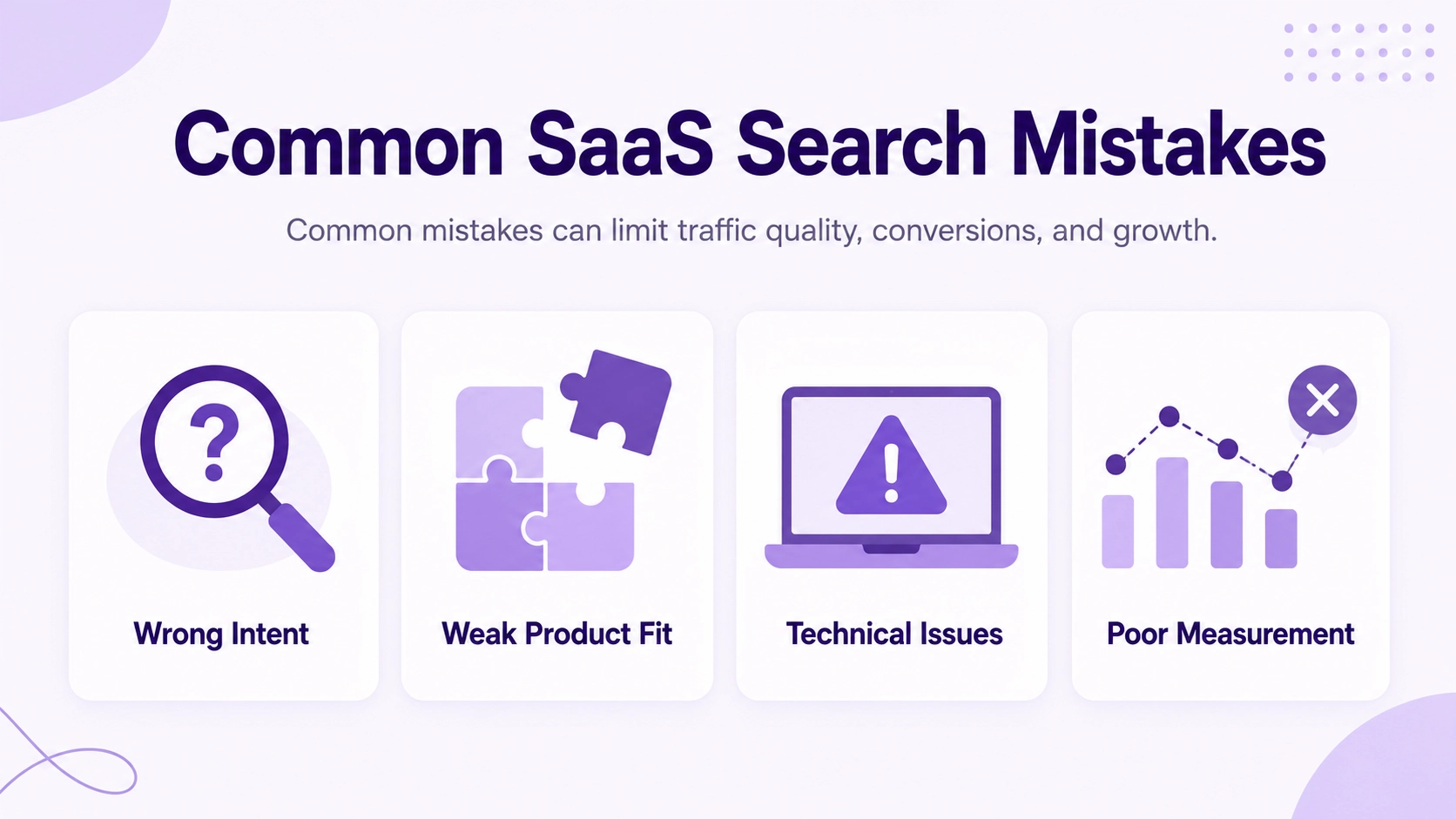
Common SaaS Search Mistakes
Common mistakes often come from treating organic search like a simple blog program. Publishing more content does not always create more useful traffic. A strong program needs intent, product fit, technical health, and measurement.
These mistakes can slow progress even when the team works hard. They can also make reports look positive while the business impact stays weak. Avoiding them helps keep the strategy focused.
Chasing Low-Intent Traffic
Low-intent traffic may increase sessions without increasing qualified leads. Broad terms can be useful for awareness, but they should not dominate the plan. If a page does not connect to the product or buyer journey, its value may be limited.
Teams should review whether traffic supports meaningful actions. A high-traffic page that brings no related clicks, signups, or assisted conversions may need a clearer role. The content may need better internal links, stronger product context, or a different target keyword.
Ignoring Product Intent
Product intent indicates whether a query aligns with what the software does. A keyword may look attractive because it has volume, but it may not bring users who need the product. This creates content that ranks but does not support growth.
Every topic should be checked against product relevance. The page should answer the user’s question and, when appropriate, show a clear relationship to the product category. This keeps the content useful and connected to business goals.
Skipping Technical Audits
Skipping technical audits can hide problems that limit performance. A site may have good content but still struggle due to crawl issues, duplicate content, slow-loading templates, poor internal linking, or rendering errors. These issues can block growth across many pages.
A technical review should happen before major content expansion and during important site changes. It should also happen after redesigns, migrations, and CMS updates. This keeps the foundation stable while content and authority work continue.
How SSinvent Reviews SaaS Search Strategy
At SSinvent, Rodrigo César and Christopher Cáceres review SaaS search programs by looking at technical access, page intent, content depth, internal links, backlinks, and conversion paths. This review helps separate traffic opportunities from pages that can support qualified leads. The process also checks whether each page has a clear role in the buyer journey. For example, this review can reveal when strong blog traffic is not connected to product pages, comparison pages, or demo paths.
Plan Your SaaS Search Strategy With SSinvent
If your SaaS website needs clearer content, stronger technical structure, and a better path from organic search to qualified leads, SSinvent can help you identify the next steps. Consult with our team to review your current pages, keyword opportunities, backlinks, and conversion paths.