SSinvent applies this concept by connecting brand positioning with technical SEO, content strategy, backlinks, and web development. Rodrigo César and Christopher Cáceres are industry professionals who work with SEO strategy, content, and digital positioning. In this context, a USP helps connect marketing efforts with search intent, user needs, and business goals.
Key Takeaways
- A USP for SEO explains what makes a brand different and connects that difference to search intent, keyword strategy, and on-page messaging.
- A strong USP can improve title tags, meta descriptions, landing pages, and blog content by giving users a clearer reason to choose one result.
- An effective USP strategy starts with audience research, competitor review, keyword analysis, and real customer data rather than internal assumptions.
- USP performance should be measured through traffic quality, click-through rate, keyword visibility, qualified leads, and conversions.
USP Meaning in SEO and Digital Marketing
USP is the clear reason a customer should choose one brand over another. In SEO, it helps search engines and users understand what makes a page different, useful, and relevant. In digital marketing, it also supports a broader marketing strategy by guiding landing pages, blog content, paid search, and marketing campaigns.
This is useful only when it reflects the needs of the target audience and target market. It should explain a real competitive advantage, not a vague claim like “best service.” A clear USP helps a page better address search intent and gives users a stronger reason to continue reading.
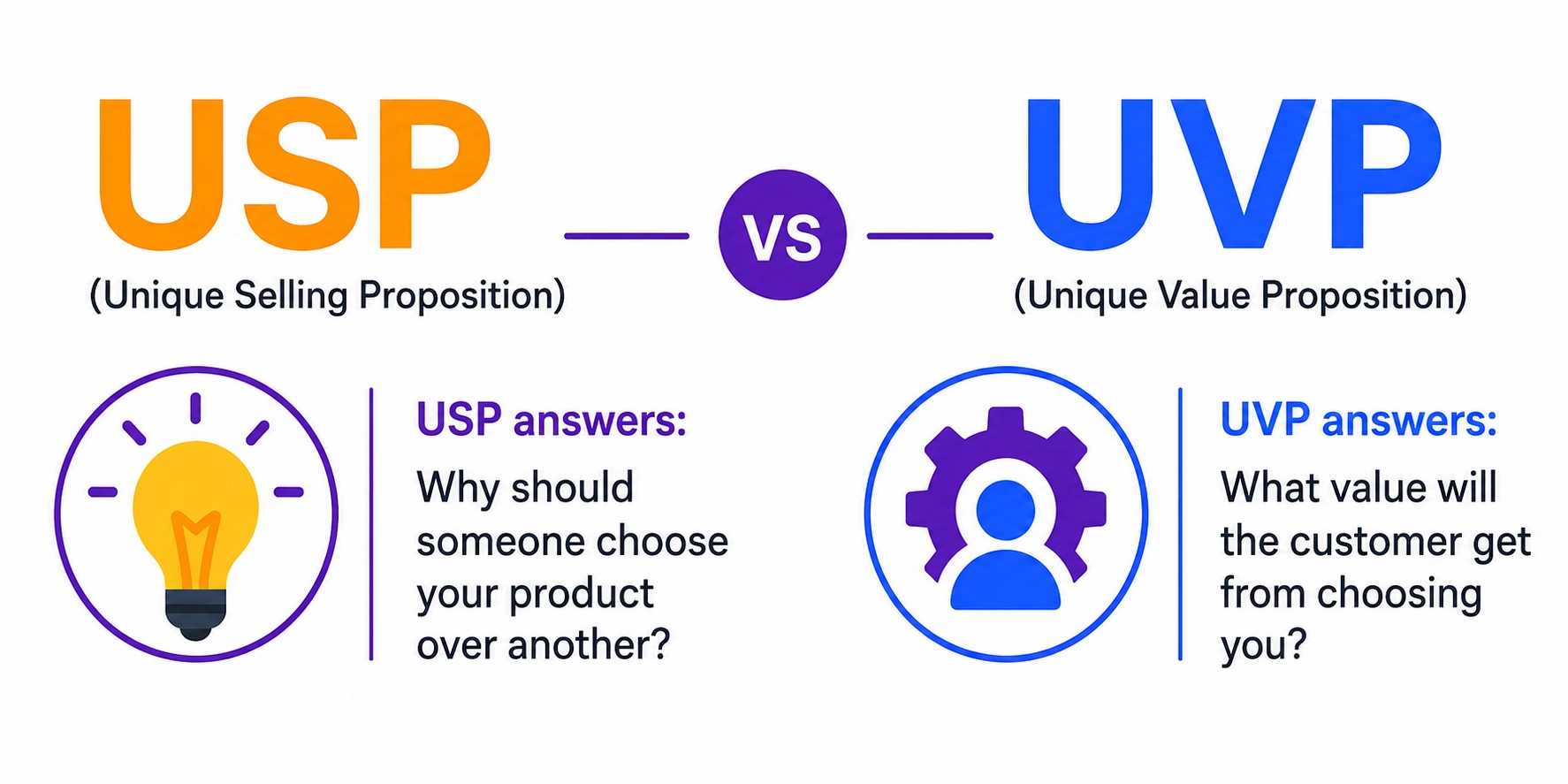
USP vs UVP in SEO
A USP and a UVP support SEO in different ways. One focuses on differentiation, while the other explains the value users receive from that difference.
- USP (Unique Selling Proposition): Explains what makes a company different from its competitors. It works well in title tags, service-page headlines, comparison pages, and landing-page copy.
- UVP (Unique Value Proposition): Explains the main value a customer receives. It works better in body content that explains benefits, pain points, and decision factors.
What Are The Four USP Categories?
USP categories help organize brand differences into clear groups. The four common categories are price, quality, service, and niche focus. These categories help a business craft a USP that fits its market and supports clearer SEO content.
Price focuses on affordability, pricing clarity, or cost structure. Quality focuses on materials, standards, accuracy, or process. Service focuses on support, response time, communication, and customer service. Niche focus targets a specific industry, location, audience, or use case.
How to Define Your Unique Selling Proposition for SEO
A USP should start with evidence, not opinion. The goal is to identify what the business does differently and connect it to search demand. The process should include audience research, competitor review, keyword analysis, and content evaluation. This keeps the USP practical and data-driven.
To craft a USP for SEO, answer these questions:
- Who is the target audience?
- What problem does the product or service solve?
- What does the business do differently?
- Why does that difference matter to the customer?
- Which search terms reflect that value?
A company’s USP should reflect what users care about, not only what the company wants to say. Useful sources include customer reviews, sales calls, Search Console queries, competitor pages, and CRM notes. These sources show which pain points are most common and which value claims already appear in search results.
How to Turn Your USP Into Keywords
A USP is useful for SEO when it aligns with keyword themes. This means turning brand differences into search phrases users already type. For example, “technical SEO for ecommerce,” “SEO content for B2B,” or “local SEO for medical practices” can reflect clear positioning.
Long-tail keywords often align better with USP messaging than broad terms because they reflect more specific needs, while short-tail SEO can help identify broader themes that need more precise positioning. A phrase like “SEO agency for Austin SaaS companies” is clearer than “SEO agency.” This makes the content easier to align with user expectations and buyer intent.
Where to Use Your USP
Your USP should appear where users make decisions, including search snippets, headings, body copy, landing pages, blog content, internal links, and clear URL structures that follow best practices for URL length for SEO.
This includes search snippets, headings, body copy, landing pages, blog content, and internal links. Do not repeat the same phrase everywhere. Adapt the message to the context of each page.
Page ElementUSP RoleExampleTitle TagShows differentiation in searchTechnical SEO Audits for SaaS SitesMeta DescriptionExplains why users should clickLearn how audits find crawl and index issuesLanding Page HeadlineStates the core offerSEO Audits for Complex B2B WebsitesBlog IntroConnects the topic to user painSaaS sites can lose rankings from crawl waste
A title tag should show the topic and value angle. A meta description should explain why the page is useful. A landing page should state the offer, audience, and main value near the top. Blog content can support the USP by explaining related problems and solutions through content marketing.
Unique Selling Proposition for SEO Examples
Compelling USPs do not need complex language. They need a clear match between value and user need.
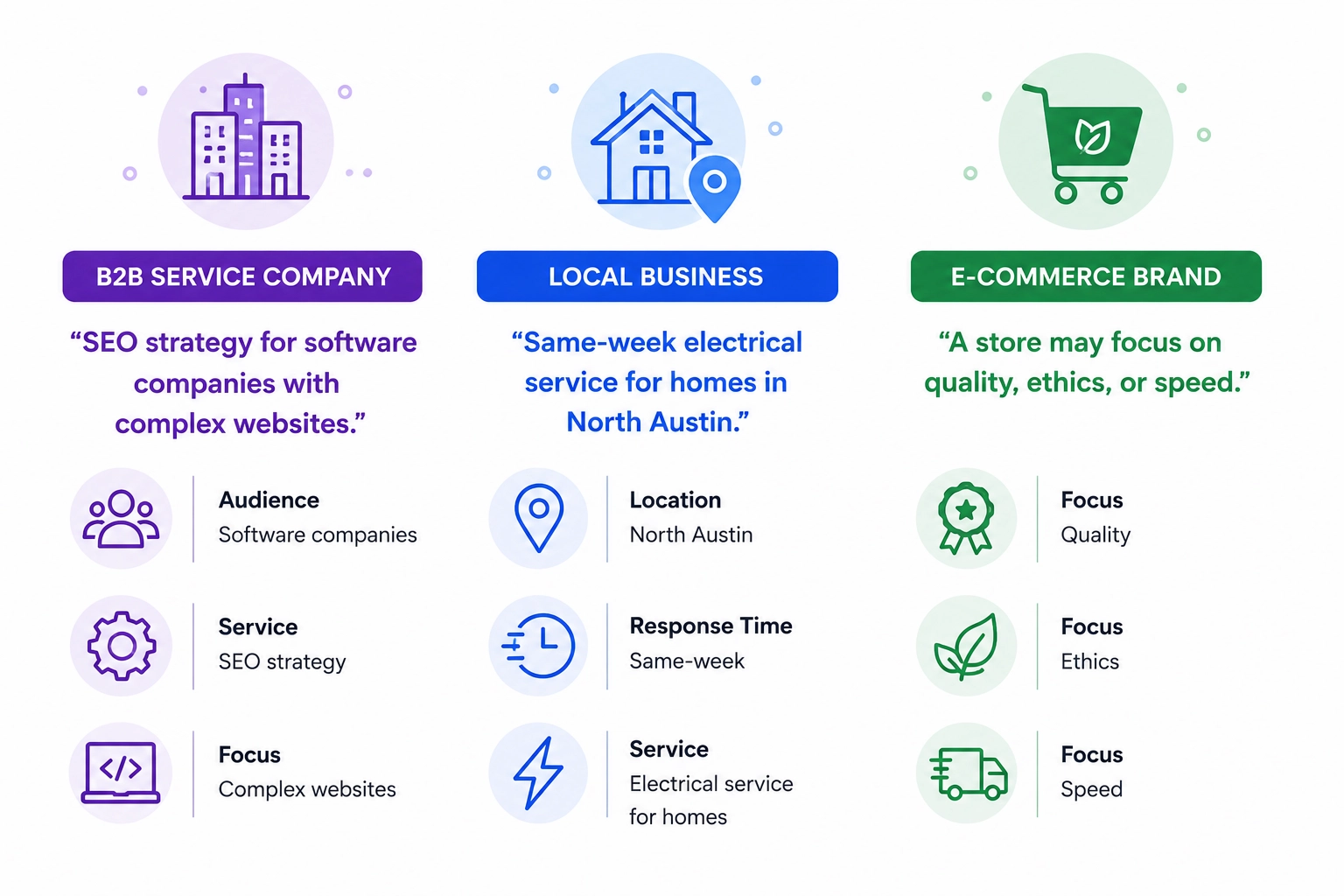
- B2B service company: “SEO strategy for software companies with complex websites.” This USP defines the audience, service, and technical focus.
- Local business: “Same-week electrical service for homes in North Austin.” This USP highlights location, response time, and service relevance.
- E-commerce brand: A store may focus on quality, ethics, or speed. Toms Shoes is often discussed in marketing because its brand story connects product choices to a broader value message
Common USP SEO Mistakes
Many businesses treat USP language as a slogan. That weakens SEO because slogans often lack search context. A better approach connects the USP to user questions, keywords, proof, and page purpose.
- Avoid generic claims like “trusted experts,” “best service,” or “high quality solutions.” These phrases do not explain what makes the business different.
- Match the USP to the correct search intent. A conversion page may not satisfy a broad educational query.
- Review competitor pages to understand the market, but do not copy their messaging.
- Use your own examples, proof, and service details to make the USP more specific and credible.
How to Measure USP SEO Results
This should be measured through traffic quality, keyword visibility, click-through rate, leads, and conversions. Rankings alone do not show whether the content attracts the right users.
Use analytics, Search Console data, CRM data, lead quality review, and SEO impressions to understand whether USP-based pages are gaining more search visibility. This gives a clearer view of how the USP supports SEO performance.
USP for SEO Checklist
- Define your target audience and target market.
- Identify the main pain points users search for.
- State your unique selling point in plain language.
- Connect the USP to keyword themes.
- Use the USP in title tags, meta descriptions, landing pages, and blog content.
- Test USP language in titles, descriptions, and landing page headlines, using SEO testing to compare changes before applying them across more pages.
- Review whether USP-based pages attract qualified leads, not only traffic.
A strong USP helps SEO content become clearer and more useful. It gives each page a defined purpose, helps users understand value faster, and supports better alignment between search intent and business positioning.
For a clearer USP, stronger SEO structure, or a page strategy built around search intent, you can consult with SSinvent. The team can review your positioning, keywords, and content structure to identify where your pages can communicate value more clearly.