It also helps you separate real improvements from normal ranking changes caused by seasonality, competitors, algorithm updates, or other external factors. At SSinvent, this topic is approached through technical SEO, content analysis, and performance measurement, so each test connects to clear search and business goals.
Key Takeaways
- SEO testing measures how controlled changes to a website affect organic traffic, rankings, clicks, and conversions.
- Strong SEO tests use a clear hypothesis, similar page groups, baseline data, and enough time to collect useful results.
- SEO testing can include title tags, meta descriptions, content updates, internal links, structured data, page layouts, and image SEO.
- A/B testing, split testing, time-based testing, and multivariate testing each serve different goals and require different levels of traffic.
- Failed SEO tests still provide value because they show which changes should be revised, retested, or avoided before scaling.
What Is SEO Testing?
SEO testing is a structured way to measure the impact of changes made to a website. Testing involves changing one or more SEO elements, then reviewing whether those updates affect search visibility, rankings, clicks, traffic, or conversions. These changes can involve content, metadata, internal links, structured data, page layout, or technical elements.
A simple test might involve changing the title tag on a blog post and tracking clicks from Google Search Console. A more advanced test might compare similar category pages, with one group receiving an update and another group remaining unchanged. This helps teams isolate the effect of the change instead of guessing what caused a ranking shift.
This testing does not guarantee higher rankings because search engines use many ranking factors, and modern search behavior continues to change with concepts like SEO 4.0. Competitors, seasonality, algorithm updates, and shifts in user behavior can affect results. A good test reduces uncertainty and helps you make better decisions as part of a larger strategy.
Why SEO Testing Matters
This approach matters because it turns opinions into measurable data. Many changes sound logical, but not every change improves performance. Testing helps you confirm whether a change supports rankings, clicks, engagement, or conversions.
This approach also lowers risk. Instead of updating hundreds of pages at once, you can test a smaller page group first. This is useful for large websites with product page templates, product page variations, location pages, or category pages.
Is SEO Testing Possible?
It is possible, but it is less controlled than testing in paid ads, email marketing, or conversion rate optimization. Search engines do not process every page change at the same speed, and rankings can shift due to algorithm updates, competitor changes, seasonality, or shifts in search demand. This means a test should not rely on a single isolated metric or a short time window.
A good test reduces uncertainty, but it does not eliminate all external factors. The goal is to compare page performance in a structured way and look for a clear pattern. This is why control groups, baseline data, similar page sets, and careful documentation matter.
Should You Run SEO Tests?
Yes, when your website has stable traffic, enough indexed pages, and a clear change you want to measure. Testing works best when pages already receive enough impressions or clicks to show a pattern. A site with very low traffic may need basic fixes or quick SEO wins before formal testing makes sense.
This testing is also useful when a change could affect many pages at once. For example, you may want to test a new title tag format before applying it to every product page or category page. If the site is new, unstable, or undergoing a major redesign, it may be better to wait until performance stabilizes.
How SEO Testing Works
This works by forming a hypothesis, choosing pages, applying a controlled change, and measuring performance. The process should focus on one change at a time when possible. This makes the result easier to read and reduces confusion.
The most important part of SEO testing is control. You need to compare the changed pages with a stable reference point. That reference point may be past performance, a control group, or a similar page set that does not receive the change.
Create a Clear Hypothesis
A hypothesis explains what you expect to happen and why. For example, you may predict that adding clearer title tags will increase clicks because users can understand the page topic faster. This gives the test a clear purpose.
A weak hypothesis says, “We will update the page and see what happens.” A stronger hypothesis says, “We will rewrite title tags to include the primary target keyword and a clear benefit, then measure click-through rate.” Clear language helps you evaluate the result.
Choose Test Pages
Test pages should share a similar purpose, layout, and search intent. If you test a product page against a blog post, the result may not be useful because those pages serve different users. Similar pages create cleaner comparisons.
For example, an e-commerce site may test only category pages in one product group. A service business may test only city landing pages with similar traffic levels. This helps reduce noise in the data.
Set Control and Variant Groups
A control group is the set of pages that does not receive the change. The variant group is the set of pages that receives the tested update. Comparing both groups helps you see whether the change affected performance.
This setup works best when pages have similar structure and traffic patterns. If both groups face the same seasonality and market changes, the comparison becomes more useful. The control group helps you avoid false conclusions.
Run Tests Long Enough
These tests need time because search engines may not process changes immediately. Google must crawl the page, process the update, and adjust how it evaluates the page. A test that ends too early may give a misleading result.
Use these ranges as starting points, then adjust based on traffic and crawl frequency:
- Metadata tests: 2 to 3 weeks
- Structured data tests: 2 to 4 weeks
- Content update tests: 4 to 6 weeks
- Page layout and UX tests: 4 to 8 weeks
Measure the Results
The final step is to compare results against the hypothesis. You should review the changed pages, the control group, and the baseline period. This helps you decide whether the change should be kept, adjusted, or reversed.
A result does not need to be perfect to be useful. Even a failed test can show what not to scale across the site. Good SEO testing supports learning, not just short-term gains.
Types of SEO Tests
There are several ways to run these tests. The best method depends on your website size, traffic level, and technical resources. Small sites often use simpler methods, while larger sites may compare page groups with more control.
Common types include:
- Time-Based Testing: Compares page performance before and after a change.
- A/B Testing: Compares changed pages against unchanged pages.
- Split Testing: Divides similar pages into control and variant groups to measure search performance more reliably.
- Multivariate Testing: Tests several changes at once, such as headlines, images, calls to action, or page layouts.
Multivariate testing requires more traffic and can be harder to interpret because several variables change simultaneously. For most websites, simpler tests are easier to manage and explain.

What You Can Test
You can test SEO elements that affect how search engines understand a page and how users respond to it. Each test should connect to a specific problem, such as low clicks, weak rankings, poor engagement, or low conversions. The clearest test ideas usually come from Google Search Console data, analytics data, crawl reports, or page performance patterns.
Common elements to test include:
- Title Tags: Test whether clearer wording, stronger relevance, or a better target keyword improves clicks and rankings.
- Meta Descriptions: Test whether a more direct summary improves click-through rate from search results.
- Content Depth: Test whether adding missing answers, examples, FAQs, or comparisons improves rankings and engagement.
- Internal Links: Test whether better anchor text or stronger link placement helps users and search engines find important pages.
- Structured Data: Test whether a valid schema improves search result visibility or click-through rate.
- Page Layout: Test whether clearer introductions, better section order, tables, or comparison blocks improve user experience.
- Image SEO: Test whether descriptive file names, alt text, compression, or image placement improves visibility and page performance.
How to Measure SEO Testing
Measurement should connect directly to the goal of the test. If the test changes title tags, clicks, and click-through rate may matter most. If the test updates content depth, rankings, impressions, engagement, and conversions may matter more.
One useful metric is SEO impressions, which can indicate whether a page appears more often in search results after a test.
- Organic traffic
- Clicks and impressions
- Click-through rate
- Rankings and visibility
- Engagement
- Conversions
You should avoid judging a test from one metric alone. SEO performance can vary across clicks, impressions, rankings, and conversions. A balanced review gives a clearer result.
SEO Testing Tools and Platforms
These tools help you collect data, compare results, and monitor changes. The right tool depends on your site size, traffic level, test type, and reporting needs.
Useful tools and platforms include:
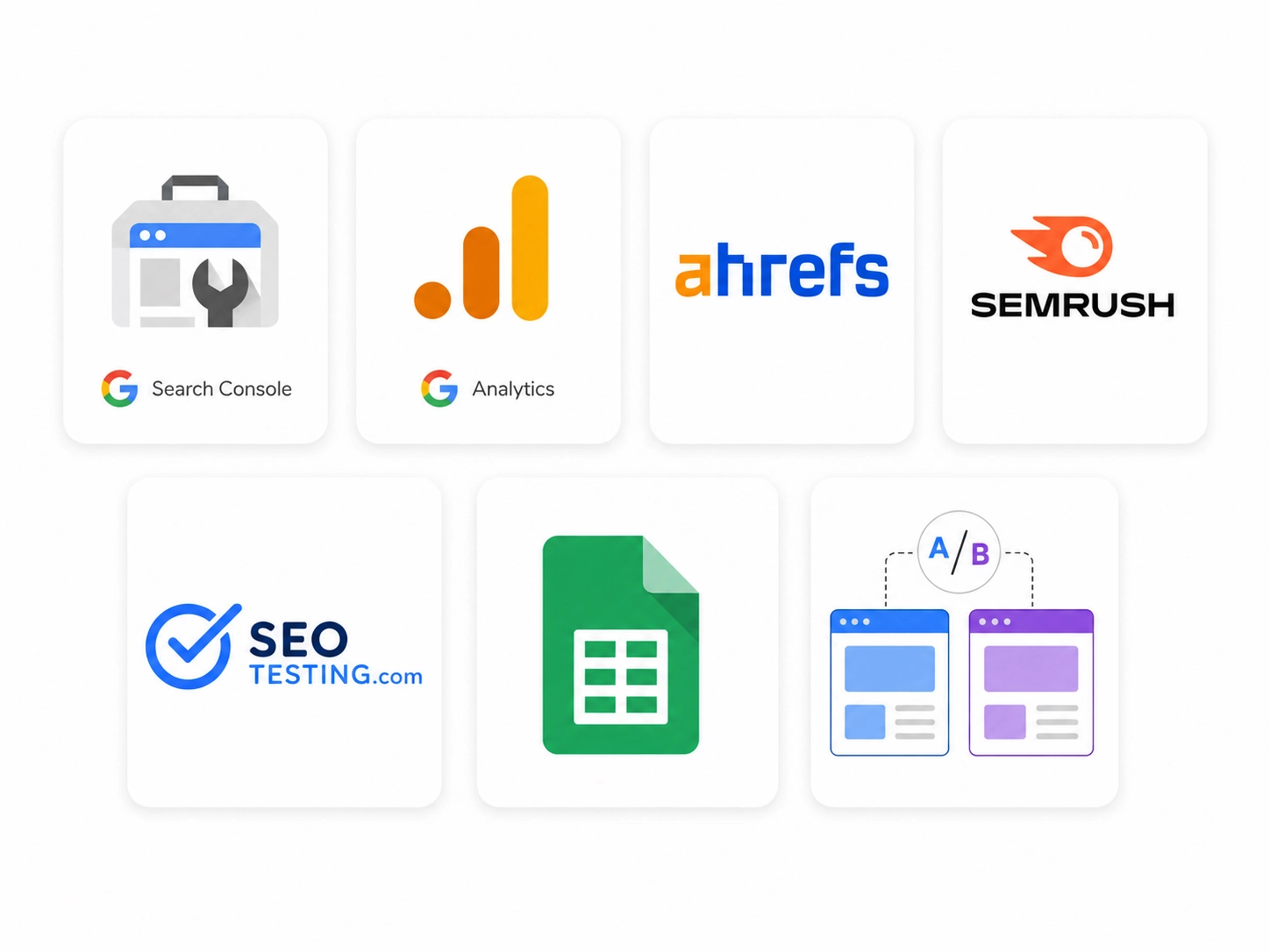
- Google Search Console: Tracks clicks, impressions, CTR, average position, and query-level search performance.
- Google Analytics: Shows how users behave after they land on your site, including engagement and conversions.
- Ahrefs and Semrush: Add context around rankings, keyword visibility, backlinks, and competitor movement.
- SEOTesting.com: Helps organize hypotheses, URLs, test dates, and outcomes using Search Console data.
- Spreadsheets: Work well for simple tests where you manually track baseline data, changes, and results.
- A/B Testing Platforms: Help compare page versions or page groups, but they must be configured carefully so search engines can still crawl and understand the content.
A/B Testing Best Practices
A/B testing best practices help improve test reliability. They reduce noise, limit confusion, and make the result easier to act on. Good testing depends more on planning than on tools.
Use similar page groups when comparing results. Pages should share the same template, purpose, traffic level, and search intent. Testing five blog posts against five category pages would yield weak data, as those pages serve different purposes.
Avoid overlapping changes during a test. If you update content, change internal links, rewrite title tags, and adjust layout at once, you cannot isolate the cause. When possible, run one test, measure it, then move to the next.
Every test should have a written record. Include the hypothesis, tested pages, control group, variant group, change date, test duration, metrics, and final result. Documentation makes SEO testing easier to repeat, compare, and improve.
Statistical significance helps you judge whether a result is likely due to the tested change or to random variation. Not every website has enough traffic for strict statistical testing. In those cases, use directional evidence, longer test windows, and careful comparison.
Common SEO Testing Mistakes
This testing can lead to poor decisions when the setup is weak. Most issues come from unclear variables, short test windows, mismatched page groups, or incomplete measurement.
Common mistakes include:
- Testing Too Many Changes at Once: If you update titles, content, links, and layout all at once, you cannot tell which change affected performance.
- Stopping the Test Too Early: SEO changes need time to be crawled, processed, and reflected in search data. Early movement may not represent the final result.
- Using Weak Page Groups: Comparing pages with different intent, templates, traffic levels, or ranking potential can lead to unreliable conclusions.
- Ignoring External Factors: Algorithm updates, competitor changes, seasonality, and search demand can affect results during the test period.
- Tracking the Wrong Metrics: A title tag test should focus on clicks and CTR, whereas a content update may need to track rankings, impressions, engagement, and conversions.
- Treating Failed Tests as Useless: A failed test can show which changes should not be scaled and where the hypothesis, timing, or page selection needs improvement.
SEO Testing Examples
Examples help make testing easier to understand. They show how a hypothesis connects to a change and a metric. Case studies can also help when they include clear methods, tested pages, time frames, and data.
A metadata test may rewrite the title tag on a page that gets many impressions but few clicks. The main metrics would be clicks, impressions, CTR, and average position. If clicks increase without a change in ranking, the new title may be more appealing.
A content update test may add missing sections to a page. For example, an article about SEO testing may add sections on tools, measurement, and common mistakes. The test should measure impressions, clicks, rankings, and engagement.
A featured snippet test may update a page section to answer a query more directly. A blog post can add a short definition, a numbered process, or a concise comparison near the top of the page. The goal is to make the answer easier for search engines and users to understand.
Example SEO Testing Workflow
A simple workflow can make the testing easier to apply. For example, choose 20 category pages with similar traffic and create 20 similar pages as the control group. Update only the title tag format on the test group, then track clicks, impressions, CTR, rankings, and conversions for four weeks.
After the test period, compare the test group against the control group and the baseline period. If the test group improves across the most relevant metrics, you can consider applying the title format to more category pages. If the result is unclear or negative, revise the hypothesis before testing again.
SEO Testing vs SEO Audits
An SEO audit identifies issues, opportunities, and technical barriers. It may find crawl problems, missing metadata, thin content, slow pages, or broken internal links. An audit explains what could be improved.
SEO testing measures whether a specific change improves performance. It answers a different question: did this change help, hurt, or create no clear effect? Audits guide decisions, while tests validate decisions.
Final Thoughts on SEO Testing
SEO testing helps you make better search decisions with clearer data. It works best when each test has a defined goal, similar page groups, enough time, and reliable measurement.
If you want to understand which SEO changes could support your site’s rankings, traffic, or conversions, you can consult with SSinvent for a structured review of your current strategy.