
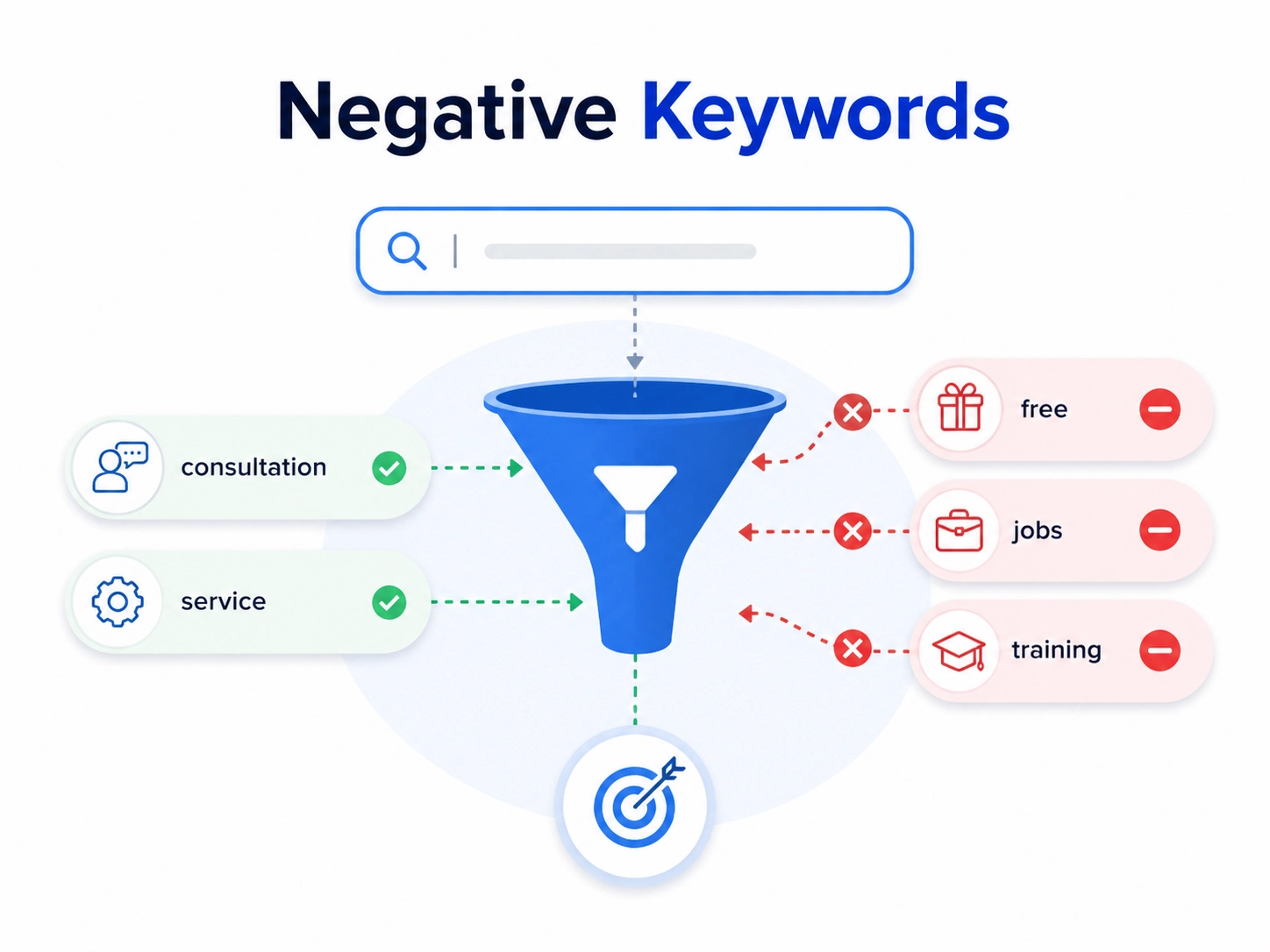
The phrase “what are negative keywords in SEO” usually refers to this difference between Google Ads exclusions and organic content planning. SSinvent uses this distinction to separate paid search controls from SEO strategy, so content can stay focused on relevant search queries.
Key Takeaways
- Negative keywords are mainly a Google Ads feature that prevents ads from showing for specific words or phrases. They do not work as a direct organic SEO ranking control.
- In SEO, negative keyword thinking helps identify irrelevant searches, poor-fit intent, and topics that may confuse a page’s purpose.
- A negative keyword list can help paid campaigns reduce wasted clicks, save money, and keep ads focused on more relevant search queries.
- Match types matter because broad, phrase, and exact negative keywords can block different search patterns. Choosing the wrong keyword match type can remove useful traffic.
- SEO teams should use negative keyword research to improve content focus, not to block organic rankings. Clear headings, focused topics, and accurate intent mapping matter more for organic search.
What Are Negative Keywords in Digital Marketing?
Negative keywords are words or phrases that tell an advertising system not to show ads for certain searches. In Google Ads, they help stop ads from showing when a search does not match the advertiser’s intent, offer, or audience. This can help reduce wasting spend on traffic that is unlikely to convert.
In digital marketing, negative keywords are primarily used in PPC campaign management, and understanding basic SEO vocabulary helps separate paid search terms from organic search concepts. They do not block organic rankings in Google Search. For SEO, they work more as a planning concept than as a technical setting.
What Is Negative Keyword Targeting?
This term means choosing search terms that should not trigger paid ads. For example, a premium service may add “free” to its negative keyword list if free-service traffic does not align with its business model. This tells the platform to stop showing ads when users search for that term.
Negative keywords can apply at the account, campaign, or ad group level. The level matters because it controls how broadly the exclusion applies inside a Google Ads account. This helps keep each keyword your ads target aligned with the right intent.

Do Negative Keywords Help SEO?
Negative keywords do not directly help organic SEO because Google Search does not let site owners add negative keywords to block rankings. A page can rank for many related search queries based on content, links, relevance, and user intent. You cannot apply negative keywords to organic SEO the same way you can inside paid search.
They can still help SEO teams think more clearly. A negative keyword strategy can reveal topics, modifiers, or user intents that do not fit a page, much like avoiding SEO keyword stuffing helps keep content focused and useful. Rodrigo César and Christopher Cáceres, as SEO industry professionals at SSinvent, would treat this as intent mapping rather than a direct ranking control.
Why Negative Keywords Are Important
These keywords are important because they reduce poor-fit traffic in paid search. They help advertisers save money by limiting clicks from users who are unlikely to need the offer. Without them, campaigns can collect wasteful ad spend from broad or unrelated searches.
They may also help protect click-through rate by reducing impressions and clicks from searches that do not match the ad or landing page. For SEO, the value is content clarity. When a team understands which topics are irrelevant, it can write cleaner and more focused content.
How Negative Keywords Work
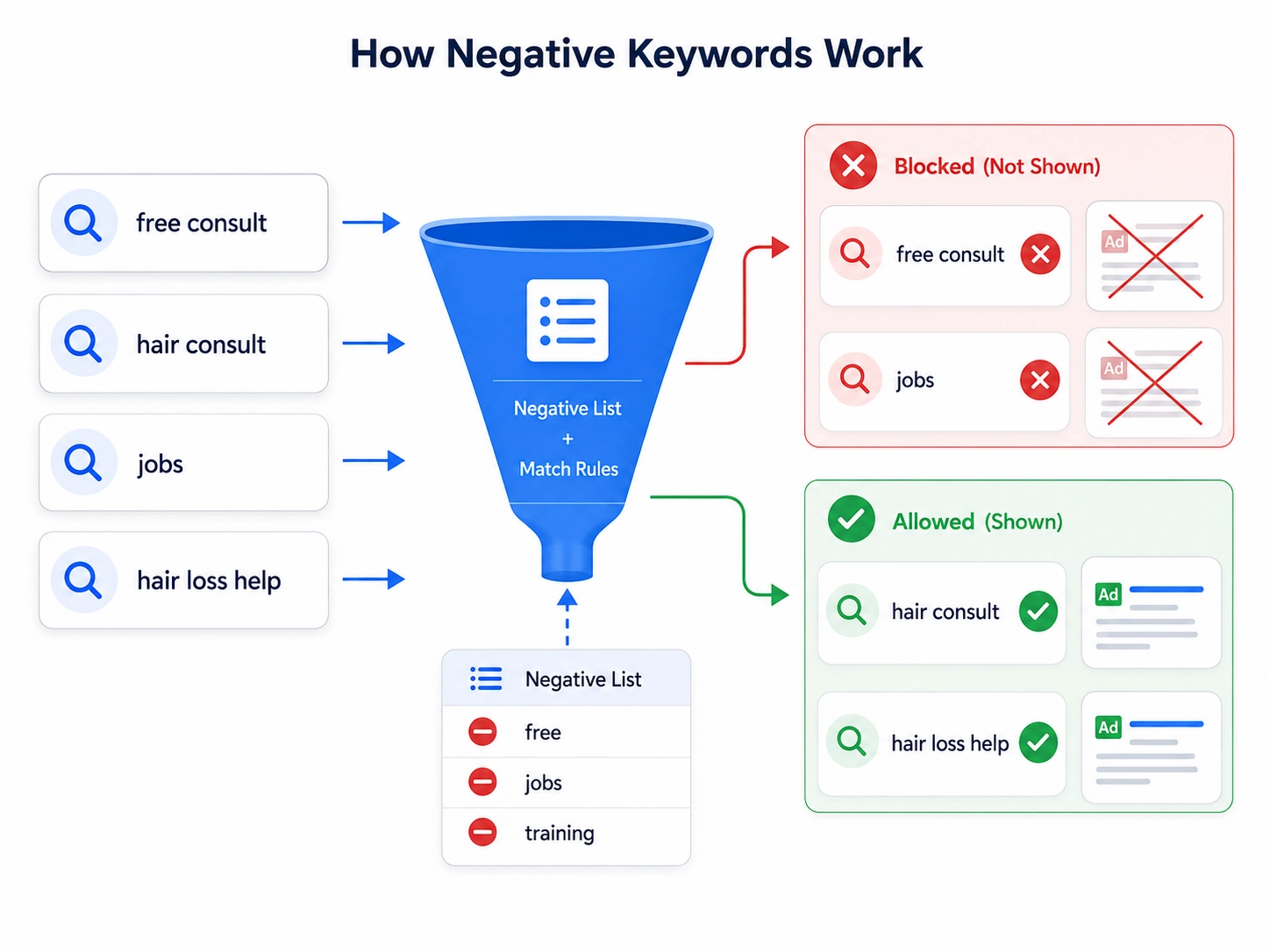
These keywords work by matching excluded terms against user searches in paid campaigns. If the search contains a blocked term according to the selected keyword match type, the ad may not appear. Google Ads does not treat all negative match types the same, so campaign managers should review search terms often.
Advertisers can build a negative keyword list from campaign data, keyword tools, and manual review. Google Keyword Planner can help identify related terms that may not match the campaign goal. Adding negative keywords then turns those findings into campaign rules.
Broad, Phrase, and Exact Match
Broad match negative keywords can block searches that include all excluded terms, even if the order of the terms changes. Phrase match negative keywords block searches that contain the exact phrase in the same order. Exact-match negative keywords block only the exact excluded search query.
For example, “free consultation” as a phrase match negative may block “free consultation for hair loss,” but it may not block “free virtual hair advice.” This is why adding negative keywords requires care. A broad exclusion may reduce irrelevant clicks, but it may also block useful searches.
Examples of Negative Keywords
Examples of negative keywords depend on the business, campaign goal, and audience. A useful negative keyword list often includes terms that signal free resources, jobs, training, unrelated locations, or low purchase intent. These terms help prevent spending on users who are not looking for the actual offer.
- For e-commerce, examples may include “free,” “used,” “repair,” or “manual PDF.”
- For local services, examples may include cities outside the service area, “jobs,” “salary,” or “training.”
- For a hair transplant clinic, patient-intent searches like “hair transplant consultation” differ from searches like “hair transplant technician jobs” or “hair transplant training course.”
How to Find Negative Keywords in SEO
To find negative keywords in SEO, review the search terms, modifiers, and topics that do not fit the page’s purpose. The process is not about adding exclusions to organic search. It is about finding content gaps, intent mismatches, and language that may attract the wrong audience.
Start with Google Search Console data, PPC search term reports, Google Keyword Planner, competitor PPC research, and manual SERP review. Look for modifiers such as “free,” “jobs,” “course,” “PDF,” “DIY,” or unrelated locations. Then decide whether to avoid, clarify, or separate those search queries into a different page.
For PPC campaigns, the next step is more direct. Review irrelevant searches, group poor-fit terms by intent, choose the right account, campaign, or ad group level, and add the terms to the negative keyword list. This keeps the process controlled and reduces the risk of blocking useful demand.
What Negative Keywords Cannot Do in SEO
Negative keywords cannot directly block a page from ranking in organic Google Search. They are not a setting inside standard SEO tools, Google Search Console, or a website CMS. Organic rankings depend on relevance, content quality, links, technical signals, and search intent.
They also cannot fully control every related query that Google may associate with a page. A page may still appear for nearby topics if its content, headings, or external signals suggest relevance.
The better SEO approach is to make the page’s purpose clear and avoid unnecessary sections that create mixed intent, especially because unclear targeting can sometimes overlap with unethical SEO practices when content misleads users.
Common Negative Keyword Mistakes
One common mistake is treating negative keywords as an organic SEO control. SEO teams should use them as research signals, not as a technical switch. Another mistake is blocking terms too quickly without checking whether they may still show useful research intent.
Some advertisers also use symbols or operators incorrectly. Terms such as “OR,” “site:,” and other advanced operators may not work in a Google Ads negative keyword setup the way they do in Google Search. A safer process is to use clear words and phrases, then confirm behavior through search term reports.
Consulting with an SEO specialist can help you separate useful keyword opportunities from irrelevant searches. If your content or paid campaigns attract the wrong traffic, a clear negative keyword strategy can help you refine targeting, reduce wasted spend, and keep your pages aligned with the right search intent.