

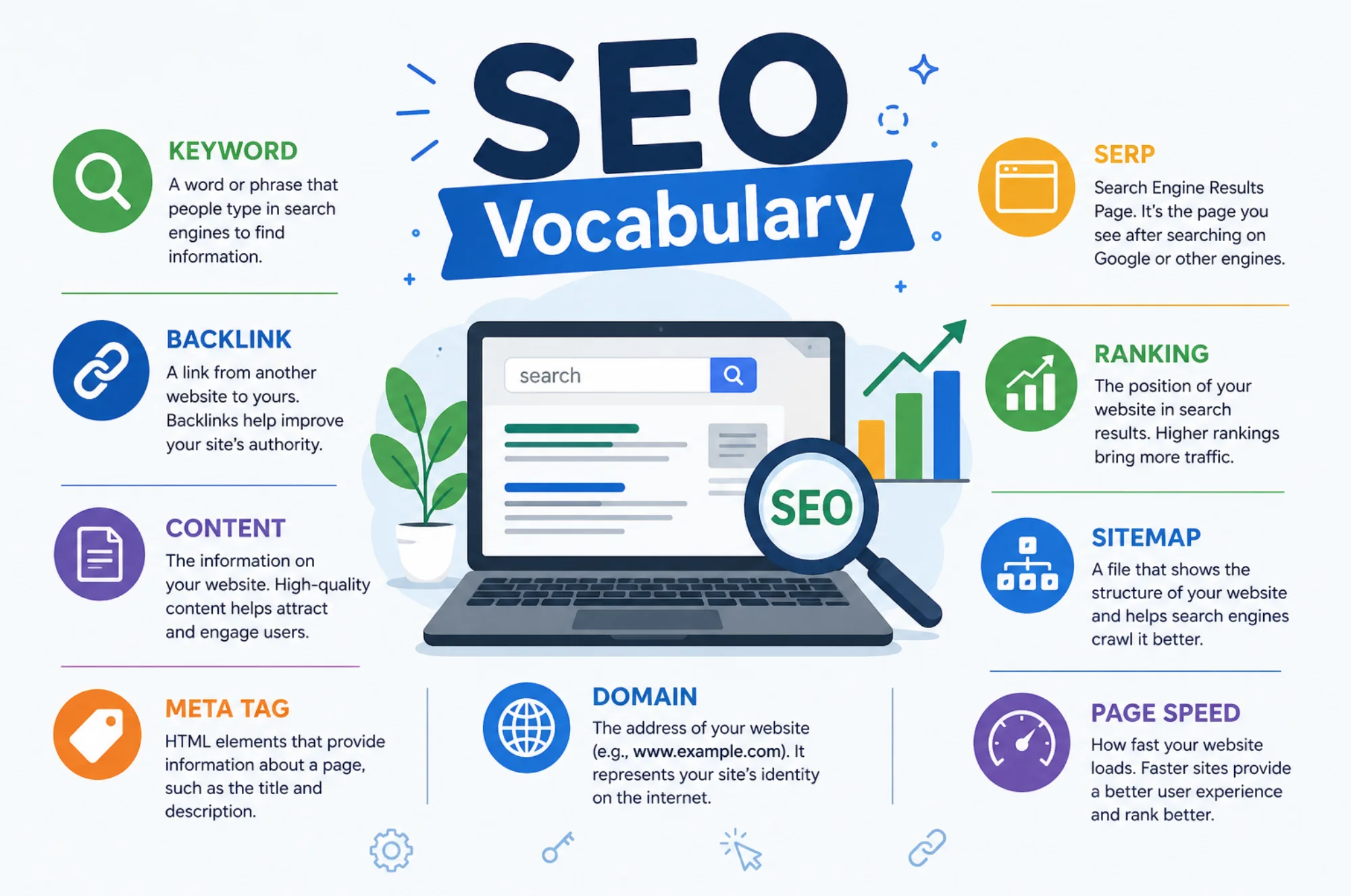
Understanding SEO vocabulary is the first step toward making informed decisions about your website’s performance in search results.
This guide covers key terms for on-page optimization, off-page strategy, technical SEO, content quality, and analytics. We group the terms by topic, so you can find what you need fast. You won’t need to search through multiple sources.
The professionals at SSinvent, including Rodrigo César and Christopher Cáceres, apply these concepts daily across client campaigns spanning the medical, construction, and home services industries.
Whether you are reviewing a monthly report or building your first SEO strategy, this guide gives you the right words.
Key Takeaways
- SEO vocabulary spans three core areas – on-page optimization, off-page authority, and technical performance – and understanding how they connect is more useful than memorizing definitions in isolation.
- On-page elements like title tags, meta descriptions, and header tags directly influence how search engines interpret a page’s topic and how users decide whether to click.
- Backlinks remain one of the strongest off-page signals, but their value depends on the relevance and authority of the linking site, not just the quantity of links pointing to yours.
- Technical factors such as crawling, indexing, canonical tags, and Core Web Vitals determine whether a page can appear in search results at all, regardless of how well the content is written.
- Google evaluates content quality through E-E-A-T signals – Experience, Expertise, Authoritativeness, and Trustworthiness – which means demonstrating real knowledge and accuracy matters more than keyword volume alone.
What Is SEO Terminology?
SEO terminology refers to the specific vocabulary used to describe how search engines discover, evaluate, and rank web pages. These SEO terms appear in audits, strategy documents, client reports, and conversations between marketers, developers, and business owners.
Knowing the difference between a canonical tag and a robots.txt file, for example, changes how you read a technical audit and what actions you prioritize. An SEO glossary like this one gives practitioners and business owners a shared reference point for clearer, more productive communication.
SEO Vocabulary List: Quick-Reference Glossary
Use this list as a fast reference before reading the full definitions below.
- Algorithm – The rules a search engine uses to rank pages
- Anchor text – The clickable text inside a hyperlink
- Backlink – A link from another website pointing to yours
- Canonical tag – HTML code that specifies the preferred version of a page
- Crawling – How search engines discover pages by following links
- Domain authority – A score estimating how well a site will rank
- E-E-A-T – Experience, Expertise, Authoritativeness, and Trustworthiness
- Indexing – Storing a crawled page in a search engine’s database
- Keyword – A word or phrase users type into a search engine
- Meta description – A short page summary displayed in search results
- Organic traffic – Visitors who arrive through unpaid search results
- PageRank – Google’s system for measuring page value based on links
- SERP – Search Engine Results Page
- Title tag – The HTML element that defines a page’s title in search results
- XML sitemap – A file listing all pages on a site for search engines to crawl
The 5 Pillars of SEO: Core Terms for Beginners
SEO operates across five interconnected areas: on-page optimization, off-page authority, technical performance, content quality, and analytics. Each area carries its own set of terms. The sections below break down the most important ones within each discipline.
Search Engine Optimization (SEO)
Search engine optimization (SEO) is the practice of improving a website to earn higher positions in unpaid search results. It involves changes to content, site structure, and external signals rather than paid placement.
Rankings are earned through relevance and authority, which makes SEO a long-term investment in sustainable organic visibility. That said, some quick SEO wins – such as fixing broken links or optimizing existing title tags – can produce measurable improvements within weeks.
SERPs, Rankings, and Organic Traffic
A search engine results page (SERP) is what appears after a user enters a search query. Each result occupies a ranked position, and higher positions consistently attract more clicks.
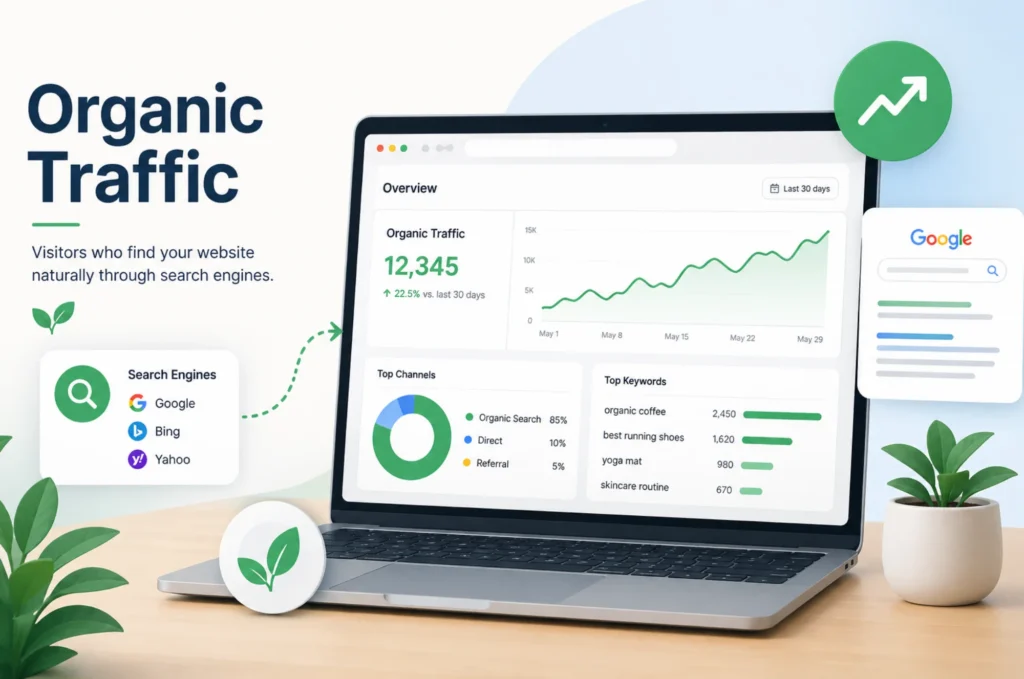
Organic traffic refers to visits generated through those unpaid positions, and improving SERP rankings is the central objective of most SEO campaigns.
Crawling, Indexing, and Sitemaps
Search engine crawlers, also called bots or spiders, follow links across the internet to discover new and updated pages. Internal links help those crawlers navigate between pages on the same site, which is why a clear internal linking structure supports faster and more thorough indexing.
After a search engine finds a page, it indexes it. It stores the page in its database. This makes it eligible to appear in results.
An XML sitemap helps by providing crawlers with a complete list of a site’s pages. This is very useful for large or new websites.
On-Page SEO Definitions
On-page SEO covers optimizations made directly on a webpage, including both the content users read and the HTML elements that search engines analyze behind the scenes.
Title Tags, Meta Descriptions, and Header Tags
The title tag is the HTML element that defines a page’s name in the browser tab and in search results. One of the strongest on-page signals for communicating a page’s topic to search engines is including the primary keyword.
The meta description appears below the title in search engine results pages and influences whether users click, though it does not directly affect rankings.
Header tags (H1, H2, H3) organize content into a logical hierarchy, and alt text added to images describes visual content for search engines that cannot interpret images on their own.
SEO Keywords: Meaning, Types, and Examples
A keyword is any word or phrase a user types into a search engine when looking for information, a product, or a service. Keyword research is the process of identifying which terms your audience uses and how competitive those terms are in search results.
Short-tail keywords like “SEO” attract high search volume but face significant competition. In contrast, a long-tail keyword such as “SEO definitions for small businesses” is more specific, easier to rank for, and often signals stronger user intent.
Search Intent, Anchor Text, and Keyword Density
Search intent is the reason behind a query – whether a user wants information, is comparing options, or is ready to take action.
Content that aligns with intent ranks better because it delivers exactly what users came for. Anchor text is the visible, clickable text of a hyperlink that signals to search engines what the linked page covers, which is why contextual links placed within relevant body content carry more SEO weight than links in footers or sidebars.
Keyword density refers to how frequently a term appears in the content relative to the total word count, and it should read naturally rather than feel forced.
Off-Page SEO Terms Explained
Off-page SEO refers to actions taken outside a website that influence how search engines assess its authority and trustworthiness.
Backlinks, Link Building, and Domain Authority
Inbound links, also called backlinks, are links from external websites pointing to a page on your site. Search engines interpret these as signals of credibility, particularly when they come from established, relevant sources.
Link building is the active process of earning those inbound links through content creation, outreach, and strategic partnerships.
Domain authority is a third-party metric that estimates how likely a domain is to rank well, based on the quality and quantity of its backlink profile.
Guest Blogging, Outreach, Local SEO, and Citations
Guest blogging means writing content for another website in exchange for a backlink to yours. Outreach is the process of contacting site owners or editors to earn links or media mentions.
Local SEO focuses on improving visibility for location-based queries, such as “electrician in Bergen County” or “dentist near me.” A citation is any external mention of a business’s name, address, and phone number, and consistent citations across directories strengthen local search rankings.
Technical SEO Vocabulary
Technical SEO refers to backend and infrastructure optimizations that help search engines access, understand, and index a site’s content without obstacles.
Redirects, Canonical Tags, and Robots.txt
A 301 redirect permanently sends users and search engines from one URL to another, preserving the original page’s ranking value.
A canonical tag tells search engines which version of a page is the authoritative one, preventing problems caused by duplicate content appearing across multiple URLs.
A robots.txt file instructs search engine crawlers on which sections of a site to access and which to skip, keeping admin areas and login pages out of the index.
Core Web Vitals, Page Speed, and Schema Markup
Core Web Vitals are Google’s metrics for measuring real-world user experience on a page, covering load speed, visual stability, and input responsiveness.
Page speed is how quickly a page loads for a visitor, and slow load times negatively affect both rankings and user experience.
Schema markup is structured data added to a page’s HTML that helps search engines understand content more precisely and can trigger enhanced displays in search results, such as FAQ dropdowns, star ratings, or product details.
Analytics and Reporting Terms
Analytics in SEO means collecting and interpreting data to understand how a site performs and where improvements can have the most impact.
SEO Data Vocabulary: Google Analytics and Search Console
Google Analytics tracks how users interact with a website, including traffic sources, session duration, pages visited, and conversion actions. Google Search Console reports on how a site performs in Google’s search results, covering impressions, clicks, average ranking position, and crawl or index issues.
Rodrigo César and Christopher Cáceres use both platforms as the base for client performance reviews. They also use third-party tools to improve keyword rankings and gather backlink data.

CTR, Bounce Rate, KPIs, and Conversion Rate
Click-through rate (CTR) is the percentage of users who click a search result after seeing it on the SERP, and a well-written title tag and meta description directly influence this number.
Bounce rate measures the percentage of visitors who leave a page without taking any further action on the site. A key performance indicator (KPI) is an agreed metric used to track an SEO campaign’s progress. A conversion rate is the percentage of users who complete a target action. These actions include a form submission, phone call, or purchase.
Content Quality and SEO Ethics Terms
How Google evaluates content quality and what it considers acceptable SEO practice have become increasingly defined and measurable over the past several years.
E-E-A-T and YMYL Explained
E-E-A-T stands for Experience, Expertise, Authoritativeness, and Trustworthiness. Google uses these signals to assess whether a page’s content is reliable enough to rank well, particularly for topics that require accurate, informed guidance.
YMYL stands for Your Money or Your Life and applies to content covering health, finances, legal matters, or safety, where Google applies stricter quality standards because inaccurate information can have real-world consequences.
Thin Content, Duplicate Content, and Freshness
Thin content refers to pages that offer little or no substantive value, such as auto-generated text or product pages with minimal descriptions. Duplicate content occurs when the same or near-identical text appears across multiple URLs, which creates confusion for search engines about which version to rank.
Content freshness matters for topics where information changes regularly, and pages that have not been updated in years often lose ground to more current competitors.
Black Hat vs. White Hat SEO
White hat SEO follows Google’s published guidelines by earning links through quality content, structuring pages clearly, and improving user experience. Black hat SEO uses manipulative tactics such as keyword stuffing, cloaking, or buying links to boost rankings quickly.
Black hat approaches may produce short-term visibility gains, but they typically result in manual penalties or ranking drops when search engine algorithms identify the manipulation.