

Search engines use concepts and relationships to connect meaning with intent, so research should focus on relevance rather than volume. Use manual review and entity recognition tools to extract likely topic signals, then validate each term by checking its source, role, salience, and fit with the user’s query.
SSinvent approaches this process as a technical content-planning method, in which each selected concept must help readers understand the topic and help search systems interpret the page.
Key Takeaways
- Entity research starts with ranking pages, SERP features, PAA terms, PASF terms, and trusted sources that show the topic’s full context.
- Keywords show what users search for, while semantic concepts show the meanings and relationships that help search engines interpret content.
- A strong research process uses manual review, NLP tools, salience checks, and source validation before adding terms to a page.
- Related concepts should appear naturally in headings, body content, schema markup, internal links, examples, and FAQs when doing so improves clarity.
- Tools can support research, but editorial judgment should determine which terms align with user intent and belong in the final article.
How to Find Related Entities for SEO
Related concepts can come from ranking pages, search results, People Also Ask boxes, autocomplete suggestions, and topic databases. A strong process starts with the main query and then expands to include tools, brands, attributes, questions, and connected entities. This helps the article convey meaning rather than match keywords out of context.
Analyze Ranking Pages
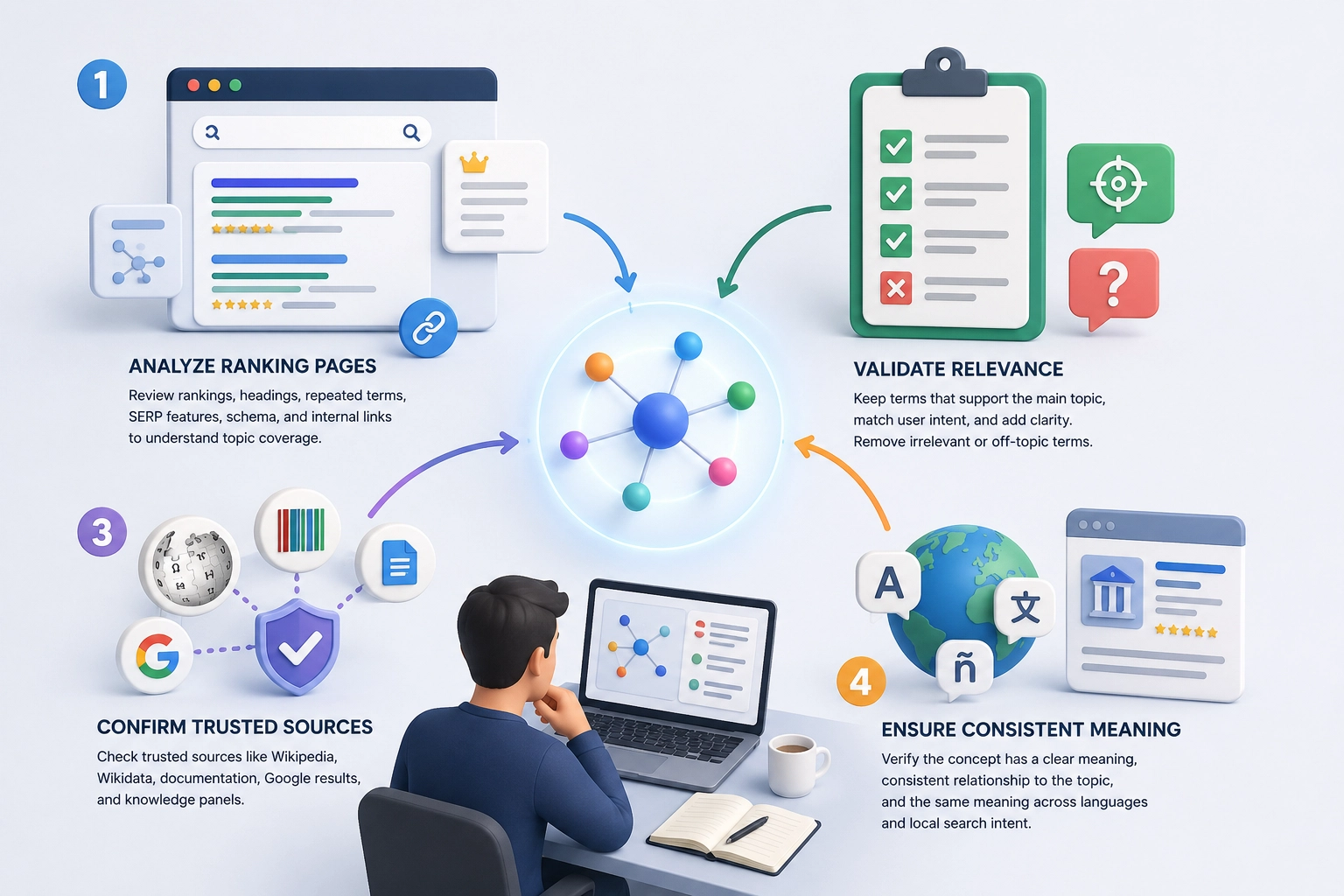
Ranking pages show which concepts Google already connects with the topic. Review headings, repeated terms, examples, schema markup, internal linking, and SERP features such as featured snippets or a knowledge panel. The goal is not to copy competitors, but to understand the subject coverage users expect.
Validate Relevance
Not every related term belongs in the article. A term is useful when it supports the main topic, matches user intent, and helps explain the subject. Remove terms that look related but do not improve clarity, accuracy, or topical coverage.
Confirm Trusted Sources
Validation should include source checks, not only tool suggestions. Review whether the concept appears in trusted sources such as Wikipedia, Wikidata, official documentation, Google search results, or a recognized knowledge panel.
A term becomes more useful when it has a clear meaning, a consistent relationship to the topic, and a role that helps the reader. For multilingual pages, review whether the same concept keeps its meaning across translated SEO content, search intent, and local terminology.
Use Manual and Automated Extraction
Extraction can be manual, automated, or both. Manual research means reviewing ranking pages, snippets, PAA results, related searches, and reference sources to identify repeated concepts. Automated research uses natural language processing systems, entity recognition models, and content analysis platforms to find topic signals in a document.
Organize Findings in a Research Table
A research table helps turn findings into a writing brief. Use columns such as term, type, source, intent match, placement, and priority. This helps you decide which concepts deserve headings, examples, schema fields, body content, or internal links.
What SEO Entities Are
SEO entities are distinct concepts that search systems can recognize and connect to other concepts. They can include people, companies, places, products, methods, events, tools, and ideas. In content work, they help define what a page is about beyond the surface wording of a keyword.
Entities vs Keywords
Keywords are the exact search phrases users type into Google, such as “seo entity tool” or “how to find related entities for SEO.” Entities are the people, places, brands, tools, concepts, and things that give those phrases meaning.
Keywords help match a page to a query, while entities help search engines understand the topic, context, and relationships behind the query. This is why keywords are still relevant in SEO, but they need context from recognized concepts and user intent.
For example, the keyword “apple nutrition” points to a search phrase, while the entity is Apple as a fruit. The keyword “Apple stock” refers to a different meaning, in which Apple is the company. This comparison shows why content should not only match keywords but also clarify the specific concept being discussed.
Topic Relationships
Topic relationships show how concepts connect. For example, natural language processing connects to entity recognition, machine learning, search interpretation, and content analysis. These links help build a clearer topic map for both users and crawlers.
Why Semantic Context Matters for SEO
Modern search depends on meaning, not only word matching. A page that explains related concepts can give a more complete answer than a page that only repeats a target phrase. This supports a stronger content strategy and connects entity planning to SEO and content marketing, as each section adds purpose and context.
Search Intent and Context
Search intent explains what the user wants to learn or complete. Context helps the page answer that need with the right examples, tools, and explanations. When both are clear, the content becomes easier for readers to follow and easier for search engines to classify.
Knowledge Graph Connections
Google can connect concepts through systems such as the Knowledge Graph. A knowledge panel may appear when a person, company, brand, or public topic has enough structured context. Content does not control that display, but clear references can support better understanding.
Internal Linking Example
Internal linking helps connect related pages into a clearer topic structure. For example, a main guide on semantic research can link to a supporting article on schema markup, a glossary page on natural language processing, and a service page on content strategy. Each link should help the reader move to a more specific or related explanation.
SEO Entity Optimization Process
SEO entity optimization is the process of finding, selecting, placing, and validating important concepts within a page. It should support the reader first, then help systems interpret the content. A practical workflow keeps terms useful, natural, and tied to the article’s purpose.
Build and Map a Topic List
Start with the main topic and collect related concepts from ranking pages, SERP features, tools, and trusted reference sources. Group the list by primary concepts, supporting concepts, tools, questions, and attributes. Then map each item to the section where it adds the clearest value.
Add Terms Naturally
Add related terms where they help explain the idea. Do not force a term into a sentence just because a tool shows it. Strong content uses clear wording, natural transitions, and examples that make the subject easier to understand.
Support Concepts with Schema
Schema markup can help define page elements such as articles, FAQs, breadcrumbs, organizations, products, and local business details. Many sites use JSON-LD because it is easy to place in the page code. Structured data should match visible content and should not add claims that users cannot see on the page.
Validate Schema Before Publishing
Schema validation helps confirm that structured data is accurate and readable. Use a schema validator to check for missing fields, syntax errors, unsupported properties, or mismatched names. The structured data should describe what users can already see on the page.

Best SEO Entity Tool Options
Tools can speed up research, but they should not replace editorial judgment. A tool can identify entity patterns, salience, and related terms, but a human still needs to decide what belongs in the article. Rodrigo César and Christopher Cáceres treat these tools as research aids within a larger SEO strategy.
Public Knowledge Sources
Public knowledge sources can help confirm whether a term is a recognized concept. Wikipedia can show common sections, related topics, and accepted terminology. Wikidata can show structured identifiers, types, relationships, and official references.
NLP and Knowledge Graph Tools
Google Natural Language API can analyze text and detect recognized concepts, categories, and salience. Google Knowledge Graph API can help confirm whether a term represents a known person, brand, place, or concept. These tools help you identify entity patterns, reduce ambiguity, and support better editorial decisions.
Prioritize by Salience
Salience shows how central a concept is within a text. A high salience score can suggest that a term plays an important role in a page or paragraph. Use salience with search intent: a term should support the main topic, address a user’s need, or clarify an important section.
How to Find Entities for SEO Optimization: Example
An example makes the process easier to apply. Imagine the topic is “semantic SEO” and the target reader wants a practical method for content planning. The editor should collect terms, group them by meaning, and place them where they support the article’s structure.
Extract Core Concepts
Start with one clear page topic and one main query. Review top pages, SERP features, related searches, and tool outputs. Look for repeated concepts such as Knowledge Graph, entity recognition, semantic search, schema, salience, and topic clusters.
Place Terms in Content
Place core concepts in headings only when they summarize the section. Use supporting concepts in body paragraphs, examples, FAQs, and internal links. This helps each term serve the reader rather than sit on the page without purpose.
Entity SEO FAQs
FAQs help answer direct questions that may not need long sections. They can also support featured snippets when each answer is clear, short, and complete. Use this section to address common points without repeating the full article.
What Are Entities in SEO?
Entities in SEO are identifiable concepts that search systems can understand and connect. They are not just words because they carry meaning in context. In a page about content planning, examples may include tools, methods, platforms, search features, and related technical terms.
How Does Google Use Them?
Google uses many signals to understand topics, relationships, and search intent. Clear references can help connect a page with known concepts, especially when the writing is organized. This does not guarantee rankings, but it can help the page communicate meaning more effectively.
Are They the Same as Keywords?
No, they are related but not the same. Keywords are search phrases, while recognized concepts are the ideas behind or around those phrases. Good content can be achieved by both answering the query and explaining the related subject clearly.
Common SEO Entity Mistakes
Common mistakes occur when writers treat this work as a checklist rather than a content-planning method. The goal is not to overload a page with terms. The goal is to make the topic clearer, more complete, and easier to interpret.
Chasing Irrelevant Terms
Some tools may suggest terms that appear in competitor content but do not fit your page. Adding those terms can weaken clarity and distract from the main answer. Keep only a concept that supports the article’s purpose.
Ignoring Search Intent
A page can include many related terms and still fail if it misses the user’s need. Search intent should guide the structure, examples, and level of detail. If the query asks for a process, the article should explain steps, not only definitions.
SEO Entity Checklist
Use this checklist to review the page before and after publishing. It helps confirm that the content explains the topic clearly, uses related concepts with purpose, and supports search understanding without forcing terms into the text.
Before Publishing
- Confirm that the article answers the main query in the introduction.
- Check that the first H2 supports the user’s main intent.
- Review ranking pages and SERP features for missing topic signals.
- Validate key concepts through trusted sources such as Wikidata, Wikipedia, official documentation, or search results.
- Make sure each related term has a clear role in the article.
- Add important concepts naturally in headings, body text, examples, FAQs, schema, or internal links.
- Remove terms that do not match the topic, search intent, or section purpose.
- Check that schema markup matches the visible page content.
- Review internal links to confirm they help users explore related topics.
After Publishing
- Review impressions, clicks, rankings, and engagement in Search Console or analytics tools.
- Check whether the page appears for relevant search results.
- Identify new PAA questions, PASF terms, or SERP features that were not included.
- Update sections that are unclear, thin, outdated, or missing useful examples.
- Add internal links from related pages when they improve navigation.
- Remove or revise concepts that attract irrelevant queries.
- Review schema after major content updates.
- Refresh the article when tools, search patterns, or topic relationships change.
Need Help with Entity SEO?
Entity research can improve content structure, topical clarity, and search relevance when handled through a clear process. For a more detailed review of your content strategy, consult SSinvent to identify gaps, map related concepts, and improve how your pages communicate meaning to search engines.