

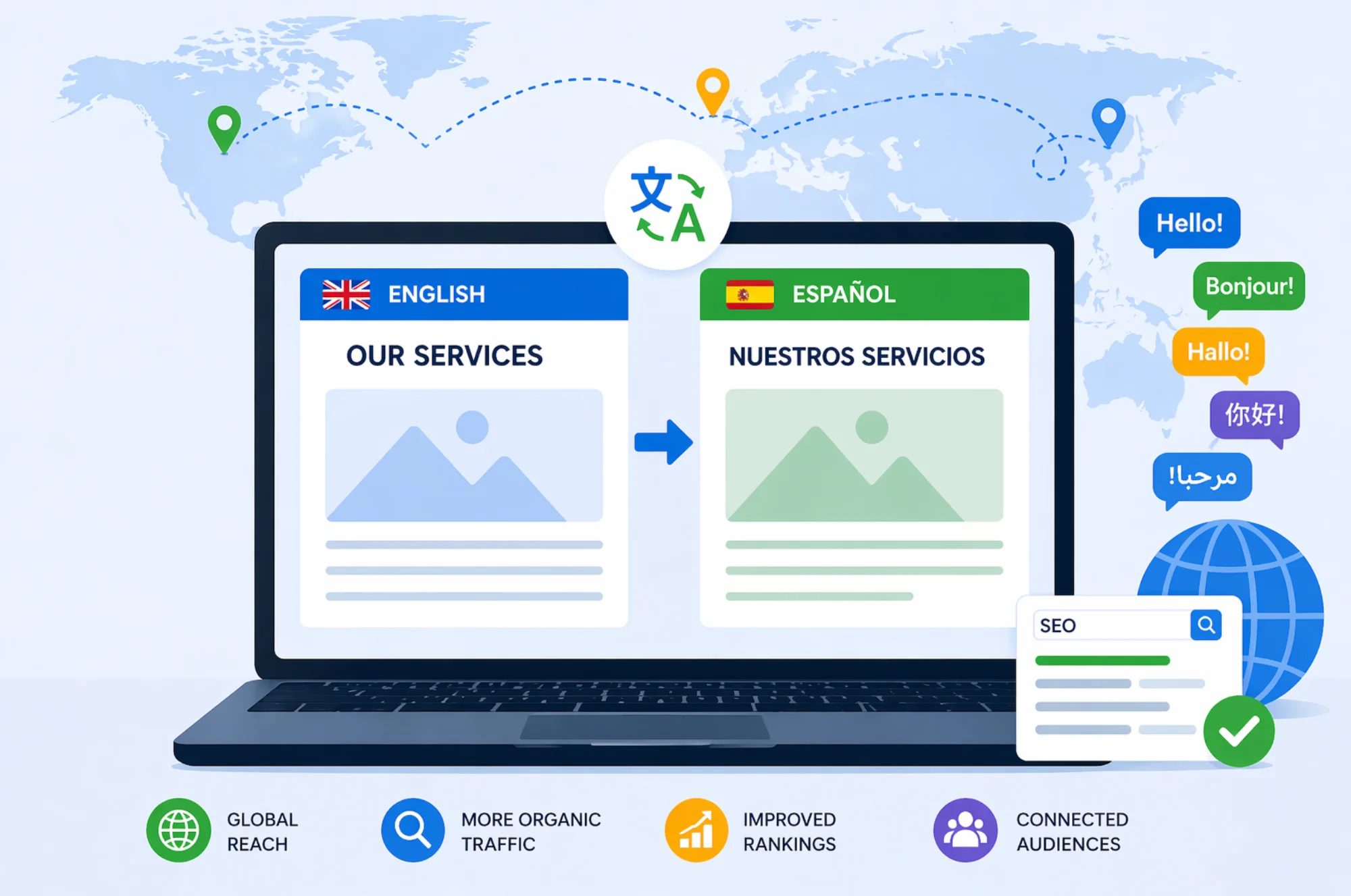
Building an SEO strategy for translated content requires more than simply translating your existing pages. Each target market has its own search behavior, keyword landscape, and technical requirements, and you must address them independently.
At SSinvent, Rodrigo César and Christopher Cáceres work with businesses that need their web pages to perform in multiple languages, not just appear in them.
This article outlines the core components of a working SEO translation strategy, from initial keyword research to technical configuration and long-term authority building.
Key Takeaways
- SEO translation is not a language task – it requires rebuilding pages in the target language using locally researched keywords, optimized metadata, and culturally adapted content that matches how users in that market actually search.
- Word-for-word translation consistently fails in search because keyword intent does not transfer across languages; conducting keyword research in the target language is the only reliable way to identify queries with real search volume.
- Technical setup must be completed before launching translated pages, including URL structure selection, hreflang tags, canonical tags, and target-language alt text – skipping any of these limits visibility even on otherwise well-written pages.
- Translating your highest-traffic pages first, rather than the full site, produces faster results and provides real performance data to guide further investment before you scale.
- Most markets take three to six months to show meaningful organic traction, so ROI should be measured at the six-month and twelve-month marks rather than evaluated against short-term traffic data.
What Is SEO Translation?
SEO translation is the process of adapting website content into another language while maintaining its capacity to rank in search engine results.
It combines a relevant keyword strategy, cultural adaptation, and on-page optimization into every translated page.
What Does SEO Translation Content Include?
SEO translated content covers every element that affects how a page is indexed: body copy, meta descriptions, headings, image alt text, URL slugs, and internal anchor text.
A complete approach to SEO website translation treats every crawlable component as part of the optimization scope.
SEO Translation vs. Standard Translation
Standard translation converts meaning from one language to another. SEO translation builds a new optimized page in the target language using search terms that reflect how users in that market actually conduct keyword research, targeting queries with real search volume.

Is SEO Dead or Still Evolving in 2026?
Search engine optimization SEO continues to evolve rather than decline. Pages that show real expertise and answer specific questions can still drive steady organic traffic. Multilingual SEO remains a less-crowded growth strategy for businesses that already rank well at home.
Why Word-for-Word Translation Fails in Search
How Search Intent Differs Across Languages
Users searching in different languages phrase the same question in ways that rarely translate directly. Conducting keyword research in the target language, rather than translating existing keywords, is the only reliable way to identify what users are actually searching for.
The Gap Between Translation and Localization
Localization adjusts website content for cultural context beyond language, including tone, examples, and cultural references. Content that is both translated and localized performs more consistently because it better matches the target audience’s expectations than a direct translation can.
SEO Translated Content Examples by Market
Spanish-Language SEO Translation in the U.S.
A home services business cannot translate its English landing pages and expect equivalent rankings in Spanish. “Plumber in Los Angeles” and “plomero en Los Ángeles” have distinct search volume figures and competition profiles.
So each page must be built from the ground up around the target-language queue. The same principle applies to any local market, whether you’re targeting Spanish-speaking homeowners or running SEO for a niche trade business.
Adapting Content for European and Asian Markets
A multilingual website that treats each language as one market will miss regional keywords. It will also underperform in local search results. French-speaking users in France and Belgium may use different search terms and references. This can happen even within the same native language.
Keyword Research for Non-English Markets
How to Find Keywords in a New Language
Start with your highest-performing English keywords, then run them through a keyword tool, filtering by target country and language.
Native-speaker input at this stage identifies natural phrasing that automated tools consistently miss, and reviewing PAA results directly on Google in the target language adds context that no tool provides on its own.
When to Keep English Terms in Translated Copy
In some markets, users search for certain concepts in their native language while mixing in English terms. Including both the English term and its local equivalent on the same page captures both search patterns and extends reach without requiring duplicate web pages.
Tools for Multilingual Keyword Research
Ahrefs and Semrush both support country and language filters for keyword data—Google Search Console shows which queries already bring international users to your site.
Social media listening tools can show how your audience discusses topics in their language. Use these insights before you do keyword research.
How Google Handles SEO Translated Content
What Google’s Guidelines Say About Translated Pages
Google penalizes low-quality translated content. This includes machine translations without editing. It also includes pages missing hreflang.
Google also penalizes pages that add no value beyond the source. The quality standard applied to translated pages is the same as for original website content.
Avoiding Machine Translation Penalties
Google can identify unedited machine translation and classify it as auto-generated content. Rodrigo César and Christopher Cáceres say that unedited machine translations are a common mistake in multilingual SEO audits. They add that every translation needs human review before publication.
How Google Evaluates E-E-A-T in Translated Content
Google applies E-E-A-T standards to translated pages the same way it does to original content. A translated page without author credentials, cited sources, or a trustworthy site structure will not compete against locally produced content that demonstrates genuine expertise in that market.
Technical Setup for SEO Website Translation
URL Structure, Hreflang, and Canonical Tags
Select a URL structure before launching translated pages: subdirectories (/es/), subdomains (es.site.com), or country-code domains (site.mx) — and pay attention to how you format slugs, since decisions like hyphens in keywords affect how search engines read your URLs across every language version.
Add hreflang tags to link each page to the right language and region. Use canonical tags to stop translated pages from being indexed as duplicates.
Image Alt Text and Anchor Text in Context
Alt text and anchor text on translated pages must use target-language keywords, not carry-over English text. Skipping this step limits visibility even on pages that are otherwise well-optimized.
On-Page Optimization for Each Language Version
Translating Metadata: Titles, Descriptions, and Slugs
Each translated page requires its own meta descriptions, meta title, and URL slug written in the target language using locally researched keywords.
Carrying over English metadata sends conflicting signals to Google and reduces click-through rates in local search engine results.
Adapting Headings and Body Copy by Language
Headings should use target-language keywords rather than direct translations of English headings. Content that sounds translated rather than written natively underperforms with both users and ranking algorithms.
SEO Translated Content in Google Ads
Ad copy in a translated campaign must reflect how users in that market phrase queries in their native language. Direct English ad translations often perform worse than native copy.
Landing pages from translated ads must match the ad’s language and keyword focus. Sending Spanish ad traffic to an English page increases bounce rates. It also lowers Quality Score across the full campaign.

How to Prioritize Pages for Translation
Approximately 20% of your pages generate 80% of your organic traffic. Translating those pages first produces faster results and real performance data before you invest further. Always confirm there is search volume in the target language before translating a page. Please prioritize keyword data over assumptions about audience overlap.
Building Authority in New Language Markets
Outreach to local journalists, bloggers, and directories in the target language helps build a link profile that signals a genuine market presence to Google.
Link between related pages within each language version using target-language anchor text, and cross-link between language versions so users always reach the correct language equivalent.
Trust signals, including local phone numbers, addresses, and reviews in the target language, confirm to search engines that your presence in that market is real.
Common Mistakes in SEO Translation
These are the most frequent failures that limit visibility on translated pages:
Over-Relying on Automated Translation Tools
- Google Translate and DeepL produce first drafts, not finished pages
- Both tools mishandle idioms, keyword placement, and natural phrasing in ways native speakers recognize immediately
- Every machine-translated page needs human editing before it goes live
- Raw machine translation published at scale triggers quality demotions across an entire language version of a site
Ignoring Local Search Behavior and Culture
- Assuming your target audience searches the same way your English-language audience does produces keyword strategies built on incorrect data.
- Search behavior differs across markets in ways that affect which terms to target, how formally to write, and what content formats perform best.
- These differences must be researched before translation begins, not after pages are already live.
Missing Technical SEO Signals on Translated Pages
- Hreflang errors
- Missing canonical tags
- Untranslated meta descriptions
- English-language alt text carried over to translated pages
A dedicated technical audit of translated pages, separate from your main site audit, catches these issues before they limit visibility across an entire market. Small technical gaps on a single page become significant when repeated across dozens of translated URLs.
Is SEO Website Translation Worth the Investment?
Track organic traffic, SEO impressions, conversions, and revenue by language in Google Analytics. Compare the cost per translated page with the traffic value at 6 months. Repeat the comparison at twelve months.
Most markets require three to six months to show meaningful traction. A site is ready to scale multilingually when its core pages rank consistently, its technical SEO foundation is clean, and its analytics already show inbound demand from a target market without any localized content in place.