

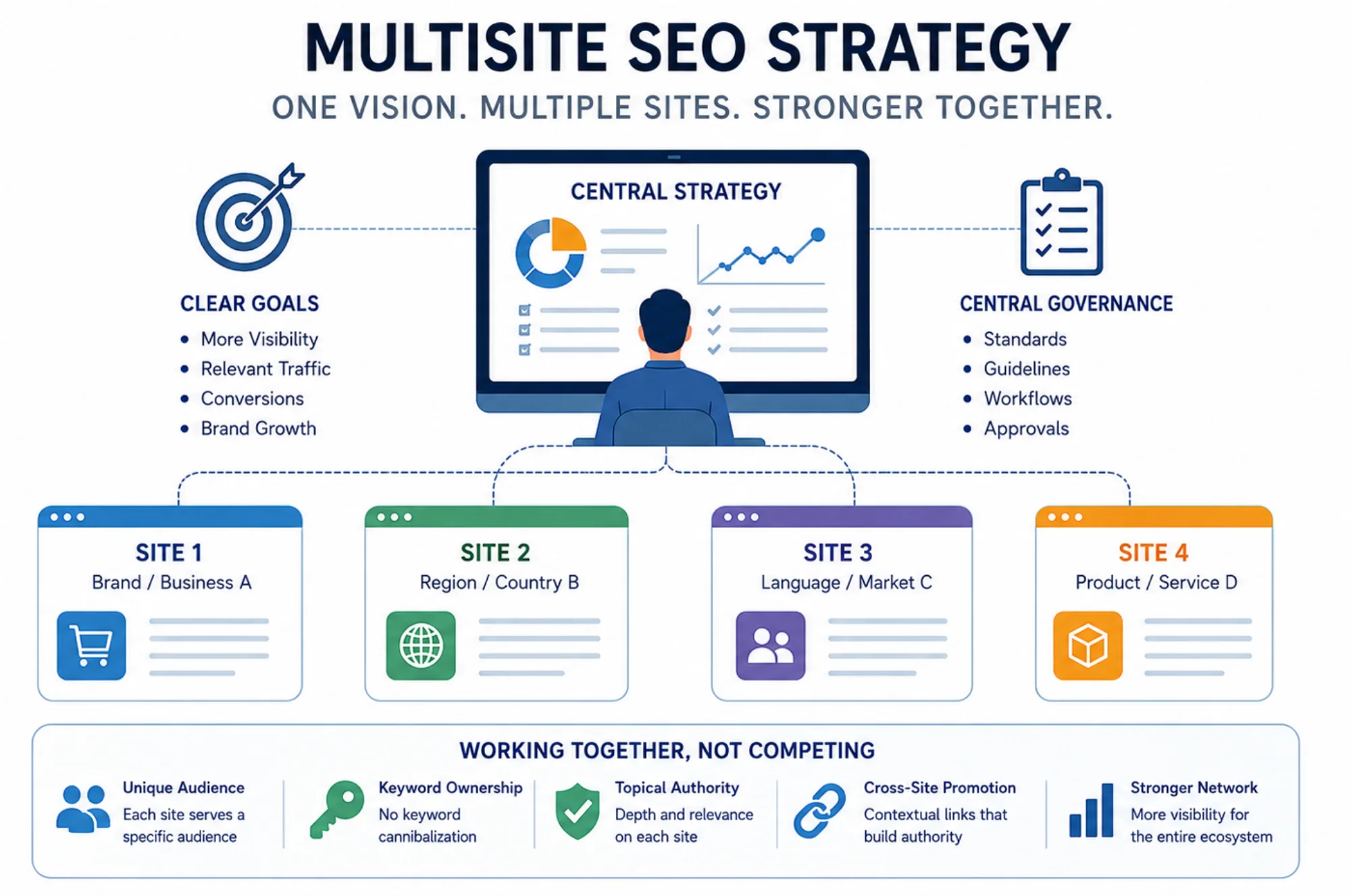
Building a multisite for SEO takes more than launching several websites. Without a plan, your sites compete with each other instead of working together.
The SEO team at SSinvent, led by Rodrigo César and Christopher Cáceres, often sees this pattern. Sites built without coordination split authority instead of building it.
This article explains how to give each property a clear role and a real path to ranking.
Key Takeaways
- A multisite SEO strategy only works when each site has a defined role, a distinct audience, and a keyword map that prevents properties from competing with one another in search results.
- The choice between subdirectories, subdomains, and separate domains directly affects how authority is distributed across your network. That decision is much harder to reverse after launch than before.
- Duplicate content is the most common technical failure in multisite environments and requires canonical tags, hreflang implementation, and regular content audits to keep under control across regional and multilingual properties.
- Crawl budget, sitemap configuration, and cross-domain GA4 tracking must be set up per domain, not assumed to carry over from other properties in the network.
- As the network grows, informal coordination breaks down fast, and the teams that scale without losing SEO consistency are the ones with documented keyword ownership, clear approval workflows, and a quarterly audit process in place from the start.
What Is Multisite SEO?
Multisite SEO means managing search optimization across multiple websites under one shared strategy. Instead of treating each site as its own project, you align keyword targeting, content, technical setup, and link authority across all properties.
The decisions you make for one site affect the others, and mistakes spread faster across a network than on a single site.
This model fits businesses that operate in multiple regions, manage separate brands, or serve different customer types from individual sites.
A company running separate sites for B2B and B2C buyers needs a multisite SEO framework so those sites support each other in search results rather than compete.
Single Domain vs. Multiple Domains
A single-domain setup keeps all content under one root URL, such as example.com/uk, and concentrates authority in one place. A multi-domain setup assigns a separate URL to each property, which adds flexibility but also means each domain starts from scratch.
Neither structure is always better. The right choice depends on your goals, your resources, and how different your audiences are.
Subdomains, Subdirectories, and Separate Domains
These three structures handle crawling and authority differently:
- Subdirectories (example.com/blog) sit within the primary domain and benefit directly from its authority.
- Subdomains (e.g., blog.example.com) are treated by Google as semi-independent and require their own ranking signals.
- Separate domains are fully independent and require a complete SEO strategy built from scratch.
Subdirectories work best for authority consolidation. Subdomains are well-suited to large content sections that need separation. Separate domains make sense when the brand or audience is genuinely distinct.
When a Multisite SEO Strategy Makes Sense
A multisite approach fits when your business serves audiences with very different needs or manages brands that can’t share a domain without confusing users and search engines.
It also applies when one domain would create keyword conflicts that hurt ranking. If a single well-structured domain can serve all your audiences cleanly, that is still the simpler and stronger SEO choice.
How Multiple Domain Names Affect SEO and Structure
Multiple domain names change how Google assigns trust and authority across your web presence. Each domain is assessed independently, so backlinks and content signals don’t carry over between properties.
Rodrigo César and Christopher Cáceres point out that the most common mistake in SEO across multiple domains is underestimating how long it takes to build authority on a new domain, especially when resources are already spread thin.
Authority Consolidation vs. Local Targeting
One domain keeps all your backlink equity in one place and produces more predictable ranking gains. Splitting across separate domains permanently divides that equity unless you later consolidate via 301 redirects.
The trade-off is local relevance. A domain like example.de sends a stronger geographic signal to Google than example.com/de, which can matter in markets where users trust local domains more.
Brand Separation and Audience Segmentation
Separate domains make sense when two brands serve audiences with genuinely different needs or price points. Putting them on the same domain creates mixed signals for both users and search engines. Separate sites let you tailor content tone, navigation, and calls to action without compromise.
ccTLDs and International SEO Considerations
Country code top-level domains like .fr, .de, or .com.au are the clearest geographic signal you can send to Google.
Each one is a separate domain that must build its own authority independently. For organizations without the resources to do so, subdirectories paired with hreflang tags are a more practical option.
Building a Multi-Domain SEO Strategy
A multi-domain SEO strategy needs a central layer that sets rules across all properties. The larger your network gets, the harder it becomes to manage multiple domains without documented standards and clear ownership. Address domain structure, content assignments, and technical standards before any site goes live.

Centralized vs. Decentralized Management
Centralized management means one team sets keyword guidelines, content standards, and technical requirements for all properties.
Decentralized management gives site teams more speed but introduces inconsistency. Most effective multisite operations use a hybrid approach: central standards with site-level execution within defined boundaries.
Content Silos, URL Structure, and Crawlability
Each site should group content into topic clusters, with related pages linking to one another and to a central pillar page. This helps Google understand what each section covers.
URL structures should be consistent across all properties, as inconsistent patterns slow crawling and make auditing harder as the network grows.
Topical Authority Across the Network
Each site should own a specific topic and cover it with enough depth that Google treats it as a relevant authority. Thin content spread across multiple sites weakens the topical signal on each one.
Concentrating depth on the right domain and linking to it from other properties produces stronger results than distributing content across separate sites.
Multi-Location and Multilingual SEO
Multi-Location SEO vs. Multisite SEO
Multi-location SEO ranks a single business across multiple cities, typically via location pages on a single domain. Multisite SEO manages multiple separate websites, each on its own domain or subdomain. A franchise may need both: a multisite network for separate locations and local SEO work within each market.
SEO for Multilingual Sites and Hreflang Tags
Hreflang tags tell Google which version of a page to show based on the user’s language and location. Without them, Google may show the wrong version or treat similar pages as duplicate content. Each language version needs its own URL and genuinely translated content, not auto-generated.
Avoiding Duplicate Content Across Regions
Duplicate content is the most common problem in multilingual SEO. Identical or near-identical pages across regional versions split ranking signals and can be filtered out of search engine results pages. Use canonical tags to mark the preferred version and run regular content audits to catch near-duplicates early.
Keyword and Content Strategy Across Sites
Assigning Keyword Ownership per Site
Every keyword in your network should belong to only one site. When two sites in the same network target the same term, both tend to rank lower than a single focused site would. Document keyword ownership in a shared map and treat it as a fixed rule during content planning.
Preventing Keyword Cannibalization
Keyword cannibalization happens when multiple pages across your network target the same query. Google can’t pick a winner, so rankings rotate, or both pages get suppressed. Run quarterly keyword overlap audits in Google Search Console to catch this before it affects traffic.
Content Requirements and Cross-Site Promotion
Each site needs content written for its specific audience. Republishing the same article across multiple domains, even with edits, creates a risk of duplicate content and weakens all versions – a problem closely related to content syndication in SEO and how search engines handle repeated material across properties.
Cross-site promotion works best with contextual internal links: when site B mentions a topic that site A covers in depth, a link from B to A builds A’s authority without copying its content.
Technical SEO for Multisite Environments
Sitemap, Robots.txt, and Canonical Tag Management
Each site needs its own XML sitemap submitted in Google Search Console, listing only indexable canonical URLs. Robots.txt files must be configured per domain, as a misconfiguration can silently block Google from crawling key sections.
Canonical tags should point to the correct page version, especially when templates or modules are shared across multiple sites, as otherwise they could cause unintended duplicate-content signals.
Crawl Budget and Internal Linking Architecture
Crawl budget is the number of pages Google crawls on a site within a set period. Sites with too many low-value pages or slow load times waste that budget and leave important pages under-crawled.
Strong internal linking to priority pages and removing non-essential pages through noindex or robots.txt are the most direct ways to protect crawl budget across the network.
Cross-Domain Tracking with GA4
GA4 tracks multiple domains within a single property via data streams. Without this setup, a user visiting two of your domains in one session is counted as two separate users, which distorts session data and conversion attribution. Please configure cross-domain measurement in the GA4 admin panel before collecting data, not after.
The Best Multisite Platforms for SEO
Is WordPress Multisite Worth It for SEO?
WordPress Multisite runs multiple sites from a single installation, sharing a codebase, database, and plugin set. It reduces maintenance overhead for teams managing similar sites.
It works well when sites share comparable technical needs, but it becomes limiting when individual sites require very different configurations.
How WordPress Multisite Works
A WordPress Multisite network has one primary installation with multiple sub-sites beneath it. Each sub-site can use its own domain through domain mapping or run as a subdomain or subdirectory.
SEO plugins like Rank Math support WordPress Multisite and allow per-site control over title tags, sitemaps, and indexing rules.
Free vs. Paid Multisite SEO Tools
- Free tier: Google Search Console and GA4 cover indexing, keyword tracking, and cross-domain analytics. Screaming Frog’s free version crawls up to 500 URLs per domain for basic technical auditing.
- Paid tier: Tools like Semrush, Ahrefs, and Rank Math Pro add cross-domain keyword tracking, backlink monitoring, and automated reporting across the full network.
For networks managing more than three or four domains, paid tools save enough time on reporting and monitoring to justify the cost.
Common Multisite SEO Mistakes to Avoid
Over-Fragmenting Domains
Too many domains is the most common structural mistake in multisite SEO. Each one needs sustained content work, backlinks, and technical maintenance to rank, and every new domain you add dilutes the SEO effort you can apply to existing properties.
Before launching a new domain, ask whether the content could live on an existing site without hurting user experience. If yes, consolidate.
Treating Sites as Competitors
Sites in the same network should support each other rather than target the same keywords and audience. When two network sites compete for the same query, both rank lower than either would alone.
The fix is practical: maintain a shared keyword map, review it during every content-planning session, and treat keyword boundaries as a standing rule rather than a suggestion.
Mishandling Migrations and Analytics Coordination
Migrations carry more risk in multisite environments because errors on one domain can affect connected properties. Use 301 redirects for every moved URL to preserve link equity, and update internal links across all network properties before going live.
Verify indexing in Search Console and monitor rankings for at least four weeks after the migration. Confirm that analytics tracking is working before the migration starts, as losing clean data during a transition makes post-launch decisions much harder.
Scaling a Multisite SEO Strategy Long-Term
Governance, Workflows, and Team Roles
Informal coordination breaks down as the network grows. Define who owns SEO decisions for each site, who approves changes, and who monitors technical health. Onboard each new site with a standard checklist covering domain setup, Search Console, GA4 tracking, sitemaps, robots.txt, and internal linking from existing properties.
Auditing, Reporting, and Future-Proofing the Network
Audit each site at least once per quarter, and if you’re working on a newer domain in the network, addressing quick SEO wins early can help build momentum while longer-term authority develops. Check for keyword cannibalization, broken links, crawl errors, and pages that dropped in ranking.
Report on the full network, not just single sites. Combine traffic, keyword coverage, and conversions from all domains. This shows where growth is happening and where more attention is needed.
A core algorithm update can hit multiple domains at once when thin content or technical issues exist across the network. Building deep content and strong technical quality from the start is the best long-term guard against ranking swings.