

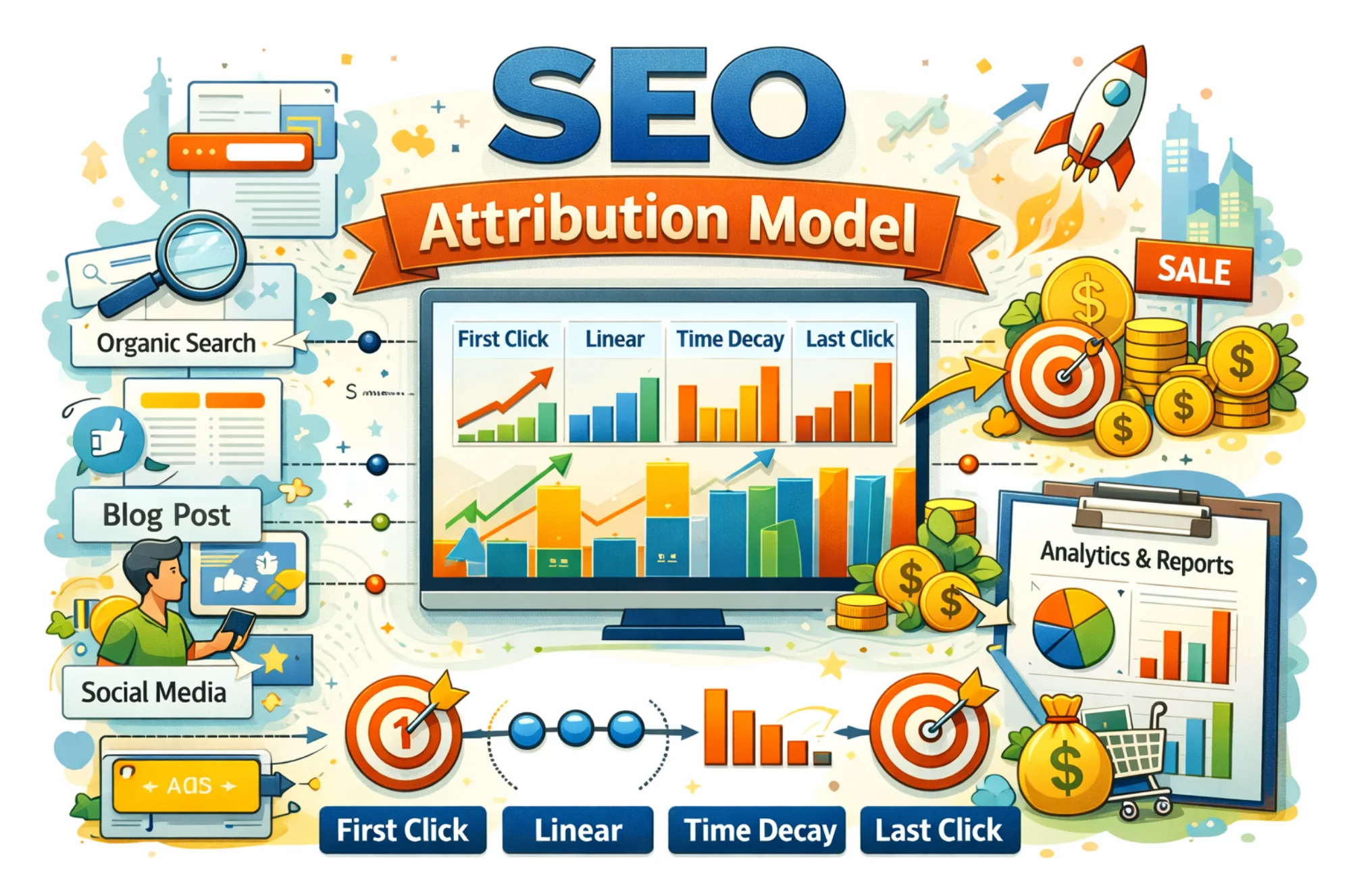
An SEO attribution model is a method for assigning credit to the touchpoints that help a user move toward a conversion. In SEO, that means measuring how organic search, landing pages, and later visits connect throughout the customer journey. This matters because SEO may start demand, while another channel records the last action.
SSinvent, an Austin-based team that works in technical SEO, content, backlinks, and web development, treats attribution as a measurement issue that requires clear rules and clear limits.
Key Takeaways
- An SEO attribution model helps teams assign credit to the touchpoints that support a conversion, so they can see how organic search contributes across the full customer journey.
- Different models answer different questions: first-touch shows what started the journey, last-touch shows what closed it, and shared-credit models show how several interactions worked together.
- SEO attribution matters because users often discover a site through search, return via other channels, and convert later, meaning last-click reports can hide the value of early SEO efforts.
- Good tracking usually combines analytics, CRM data, landing page analysis, self-reported attribution, and assisted conversion reporting to build a more complete view of performance.
- Attribution has limits, so teams should pair it with trend analysis, testing, and broader measurement methods to understand how SEO supports business results over time.
What Is the Attribution Model in SEO?
In SEO, attribution is the process of deciding how much value search traffic should receive when a lead or sale happens. An SEO attribution model sets the rules for that decision.
Some models credit the first visit, some credit the last visit, and some split the value across several steps. The goal is to understand how SEO attribution supports the broader digital marketing journey.
Why do people miss SEO credit?
SEO credit gets missed because users rarely convert on the first visit. A person may find a page via Google search, leave, return via paid search, and convert later via email or direct traffic.
If a report only counts the final click, early seo efforts lose visibility, and for SaaS teams, this issue can overlap with common SaaS SEO mistakes. That is why click attribution by itself can misread the role of discovery content and blog posts.
Why does SEO Attribution Matters?
SEO attribution matters because search often supports awareness, research, and comparison before the final action. A page may answer a question, guide the next search, and lead users to stronger landing pages later.
This gives teams a fuller view of marketing efforts, not just the last click. It also helps connect SEO to a broader marketing strategy.
Measure SEO’s Real Impact
Attribution helps teams see which pages assist leads and revenue, even if those pages do not close the conversion. This is useful for blog posts, resource pages, and service pages that support users early in the path.
Rodrigo César and Christopher Cáceres can be viewed here as SEO professionals who study attribution as a system question, not just a report view. That matters because SEO attribution often spans multiple sessions and marketing channels.
Support Better Budget Decisions
Attribution also helps teams decide where to allocate time and money. If organic search starts the journey but paid ADS close more conversions, both facts matter. A better report helps a team shape seo strategy, paid media planning, and future marketing efforts with less bias. This is especially useful in businesses with long sales cycles.
Main Types of Attribution Models
The main models answer the same question in different ways: which touchpoint should get credit, and how much should it get. No model fits every business because each one reflects a different view of user behavior. The best option depends on the reporting goal, the journey length, and the role of each channel in digital marketing.
First-Touch and Last-Touch Attribution
First-touch attribution gives full credit to the first known interaction. It helps when the team wants to know which source starts demand or introduces new users. Last-touch attribution gives full credit to the final interaction before conversion. It is simple, but it can understate SEO when organic search begins the path and another channel ends it.
Linear and Time-Decay Attribution
Linear attribution splits credit evenly across all tracked touchpoints. This model is useful when every step in the path matters. Time decay attribution gives more credit to touchpoints closer to the conversion. It can fit short decisions, but it may reduce the value of early educational content.
Position-Based and Data-Driven Attribution
Position-based attribution gives more weight to the first and last interactions, while still sharing value with middle steps. This can work well when both discovery and closure matter.
Data-driven attribution uses observed patterns to assign credit based on how different touchpoints tend to contribute. It can be helpful, but it depends on platform logic and data quality.
Attribution Model Example
A short example shows why attribution can change the story. Imagine a user finds a page through Google search, reads a guide, leaves, returns later through branded search, and then submits a form. Each model will read that path differently. The journey stays the same, but the assigned credit changes.
A Simple SEO Conversion Path
In this example, first-touch attribution gives credit to the first visit from organic search. Last-touch attribution credits the final session before the form submission. Linear attribution shares value across the main visits. The purpose is not to prove one report is always right, but to show that each model answers a different question.
How do we assign credit?
Model rules, not guesswork, assign credit. If the goal is to identify what started the journey, first-touch can help. If the goal is to understand what closed the action, last-touch may be more helpful. If the question is what drives conversions across the full path, a shared-credit model may offer a better view.
How to Choose the Right Model?

The right model depends on the business question. A team should choose a model that matches its reporting goal, not just the default setting in a tool. That is why attribution should support a larger marketing strategy with clear goals for traffic, lead quality, and conversion value.
Best for Short Sales Cycles
Short journeys often work better with simpler models because fewer interactions occur before conversion. A local business with direct-response landing pages may learn enough from first-touch, last-touch, or a simple shared model. These paths are easier to track, but teams should still compare reports before making decisions.
Best for Long Buyer Journeys
Longer journeys require more context because users often return to the same pages multiple times. In B2B or high-consideration services, users may read blog posts, compare offers, and return later before acting.
In these cases, position-based attribution or data-driven attribution can show more than a last-click report alone. The longer the path, the more likely it is that SEO assists rather than closes.
Best for Multi-Channel Reporting
When several marketing channels influence the same user, the model should reflect that path. A person may move from organic search to paid search, then email, then direct traffic before converting. Multi-channel reporting helps explain how SEO supports discovery, comparison, or trust across the path. That is often more useful than asking only what happened at the final click.
How to Track SEO Attribution?
Tracking starts with clean goals, clear page groups, and a standard conversion definition. Teams need to know which visits come from search, which pages support discovery, and which pages move users toward action. A good setup will not remove all uncertainty, but it reduces guesswork and improves reporting quality.
Analytics, CRM, and Landing Pages
Most teams start with web analytics and CRM data. Google Analytics is often used to review sessions, sources, events, and conversion paths. CRM records help connect visits to lead quality, deal stage, or revenue after the form is submitted. This makes it easier to connect landing pages and product page SEO work to business results.
Self-Reported Attribution and Lead Forms
Self-reported attribution adds direct input from the user. A short field, such as “How did you hear about us?”, can capture data that analytics tools might miss. This helps when shared links, dark traffic, or cross-device behavior hide the real first touch. It also gives teams a useful qualitative check against measured data.
Assisted Conversions and Attribution Windows
Assisted conversion reports show when SEO supported a result without receiving final-click credit. Attribution windows matter because a short window may overlook early-discovery content.
This becomes more important in longer sales cycles, where users return weeks later. Teams should choose windows that reflect real behavior, not only tool defaults.
Limits of SEO Attribution
SEO attribution has limits, and those limits should be stated clearly. Tracking tools do not see every action, person, or device with full accuracy. Browser restrictions, consent settings, and platform gaps reduce visibility. That means attribution is informed measurement, not exact measurement.
Offline Touchpoints and Privacy Gaps
A user may discover a brand online, discuss it offline, and return later to convert. That offline influence may matter, but analytics tools will not capture it. Privacy changes also reduce user-level tracking, which makes measurement harder across digital marketing systems. Reports can show patterns, but they cannot show every influence.
Why SEO Is Hard to Isolate?
SEO is hard to isolate because it interacts with brand, product, price, and other marketing channels. A page may rank well, but conversion still depends on the offer and what happens after the visit.
Search demand can also increase because of PR, email, social content, or paid ads. That is why attribution should focus on contribution rather than total isolation.
What does 7-Day Click 1-Day View mean?
The phrase “7-day click 1-day view” refers to an attribution window commonly used on ad platforms. It means a click can receive credit within seven days, while a view can receive credit within one day.
Even though this is more common in paid media, it helps readers understand how time limits shape reporting. Attribution windows affect what a report can count.
How to Prove SEO Value?
Proving SEO value usually takes more than one dashboard. Teams should combine attribution reports with trend analysis, lead quality data, and business results over time. A single report rarely explains the full effect of seo efforts across the path.
Use Incrementality Testing
Incrementality testing asks what changes when SEO activity changes. A team may compare technical fixes, content changes, internal link updates, or quick SEO wins against a control period.
This does not eliminate all external factors, but it can improve confidence in the result. It is one useful way to test whether SEO contributed to later performance.

Compare Trends Over Time
Trend comparison helps teams connect SEO activity to later outcomes without relying only on single-session reports. They can compare assisted conversions, lead volume, and page engagement before and after major changes. This helps when last-click reports miss the role of discovery content and early search behavior.
Use Marketing Mix Modeling
Marketing mix modeling looks at how channels work together over time. It does not rely on user-level paths in the same way that direct attribution tools do.
For brands with larger budgets and mixed online-offline activity, it can add context when attribution data is incomplete. It should be used as a complement, not a replacement.
SEO Attribution Model FAQs
What Are the Four Types of Attribution?
- First-touch attribution gives full credit to the first interaction.
- Last-touch attribution gives full credit to the final interaction before conversion.
- Linear attribution splits credit evenly across all tracked touchpoints.
- Time-decay attribution gives more credit to touchpoints that happen closer to the conversion.
These are usually the easiest to explain and compare. Many teams also review position-based and data-driven options.
Which SEO Attribution Model Is the Best?
There is no single best model for every business. The right choice depends on goals, data quality, channel mix, and journey length. Many teams learn more by comparing several models than by relying on one default.
Can SEO Be Measured Alone
SEO can be measured at the traffic and page levels, but its business impact is harder to fully separate from the rest of the journey.
A visit may start with organic search and end with email, direct traffic, or paid search. The goal is not perfect isolation, but a clear view of how SEO supports the path.