


Many business owners want to know if SEO brings real value or just adds cost. The clear answer is that SEO services can be worth the investment when they match a company’s goals, budget, and time frame. SEO helps improve visibility in organic search results, supporting a long-term online presence rather than short-term wins.
This article explains what SEO services do, when they add value, and how to judge results in a clear, practical way, using SSinvent as a contextual example of a company working in this field.
SEO services aim to improve how search engines understand and rank a website. This work often includes technical checks, content planning, and ongoing updates. The goal is not to control rankings but to improve how pages match real search behavior. Understanding this scope helps explain why SEO works slowly and why results differ between businesses.
Key Takeaways
- SEO services can be worth the investment when they align with business goals, search demand, and realistic timelines, especially for companies seeking long-term organic visibility.
- SEO still works when it focuses on relevance, clear content, and user experience rather than shortcuts or keyword stuffing.
- Small and local businesses often gain the most value from SEO when customers actively search for their products or services.
- Paying for SEO can make sense when internal teams lack time or expertise, but results depend on clear scope, transparency, and patience.
- SEO is not always the right choice, and comparing it with paid ads helps businesses decide which channel best fits their goals and time frame.
Is SEO Worth It for Small Businesses?
For small businesses, it usually comes down to demand and competition. If people search online for your products or services, SEO can help you reach potential customers at the right moment. These users already have intent, which makes organic traffic useful. Over time, this can support steady growth in online presence.
Small businesses should also review how customers find them today. If most leads come from word of mouth or direct referrals, SEO may play a supporting role instead of a main one. When search engines already influence buying decisions, SEO becomes more relevant. This check helps avoid investing in channels that do not match customer habits.
Small businesses must also consider limits. SEO takes time, and early results may be slow to come. Budgets are often tight, making it harder to invest in SEO at the start. Still, when compared with paid ads that stop once spending ends, SEO can be more cost-effective in the long run.
KopelmanHair.com began as a single clinic in New York City. Through a coordinated SEO strategy and close collaboration with Dr. Kopelman, the practice achieved sustained growth in organic visibility, now exceeding 30,000 monthly visits that translate into consistent patient acquisition.
Dr. Kopelman now runs one of the most successful hair restoration clinics in Manhattan and ranks for thousands of relevant search keywords. This growth supported expansion into New Jersey and Florida, where the practice continues to scale successfully.
Kopelman Hair ranks in second place for the highly competitive keyword “hair transplant NYC” at the time of writing, widely considered one of the most difficult terms to rank for in this market.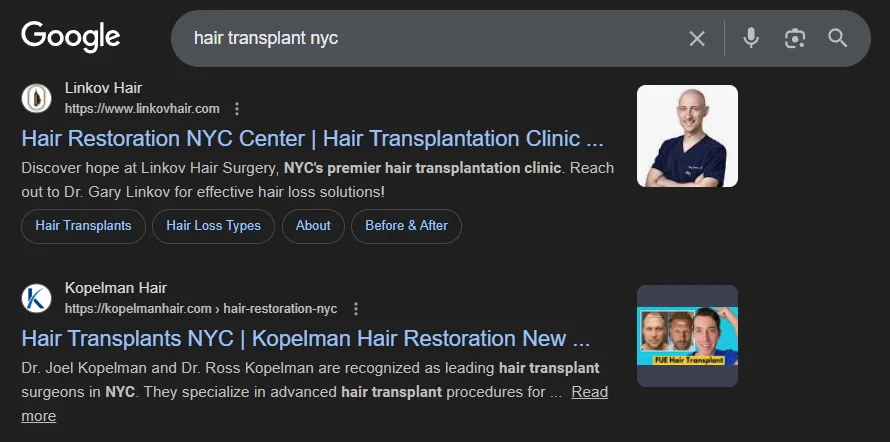
Does SEO Really Work Today?
This question reflects doubt about how search engines rank pages today. SEO still works when it focuses on relevance, clarity, and user experience, supported by advanced SEO services that address technical and content factors. Search engines continue to rely on content quality, site structure, and authority to rank pages.
Search engines now reward clear answers, helpful structure, and easy navigation. Pages that solve a user’s problem tend to perform better than pages written only for ranking. This shift explains why SEO and user experience now overlap. Effective SEO improves both search visibility and site usability.
Modern SEO is not about tricks or shortcuts. It is about matching content to search queries and helping users find clear answers. Effective SEO improves page speed, structure, and content quality. When done this way, SEO continues to support organic search results.
Is Local SEO Worth It?
Local SEO focuses on searches tied to a place or area, often supported by a dedicated local SEO agency that understands geographic intent. For businesses that serve a city or region, local SEO can be worth the investment. It helps companies appear when users search for nearby products or services. These searches often show strong intent and lead to quick decisions.
Local SEO is most useful when customers act quickly after searching. This includes services like repair, healthcare, or local retail. In these cases, showing up in local results supports direct contact or visits. Businesses without local intent may see weaker results from local-focused efforts.
Local SEO is different from broader SEO strategies. It relies on accurate business details, local content, and reviews. Competition is often lower, which can make achieving results easier. Still, local SEO needs regular updates and monitoring to stay effective.

Is It Worth Paying for an SEO Company?
A common question is whether it is worth paying for SEO instead of doing it in-house. Paying for SEO through an SEO agency or SEO specialist can provide skills and tools that many teams lack. SEO services often include audits, technical fixes, and guidance on content creation. These tasks require steady work and ongoing review.
Paying for SEO does not remove all risk. Results depend on clear goals and realistic plans. Businesses should understand the services they will receive and how progress will be tracked. Paying for SEO is most useful when teams lack the time or experience to manage complex SEO strategies.
An SEO company does not control search engines or rankings. Its role is to apply tested methods and reduce guesswork. Clear communication and reporting matter more than promises. Paying for SEO works best when expectations are defined early.
How Much Does SEO Cost?
Cost plays a major role in determining whether SEO is worth the investment. SEO pricing varies based on scope, market competition, and service level. Some SEO services use monthly plans, while others focus on short projects. Costs usually cover labor, tools, and analysis rather than outcomes.
Costs often reflect time and effort rather than outcomes. Research, audits, and content planning all require skilled labor. Lower prices may limit depth, while higher prices may not always improve results. Comparing scope instead of price alone leads to better decisions.
Understanding cost also means knowing what SEO can replace. Paid ads often require ongoing spend to sustain traffic. SEO can support long-term organic search results once progress is made. For many businesses, investing in SEO becomes cost-effective over time.
At SSinvent, our SEO strategies typically range from $1,500 to $4,500 per month, depending on the amount of content produced and overall project complexity. While no one can guarantee results, we see performance compound over time for our clients, and we typically 5X a customer’s investment within the first 12 to 14 months, sometimes more.
What Is the 80/20 Rule for SEO?
The 80/20 rule for SEO means that a small number of actions often drive most results. In SEO, this typically involves resolving technical issues, improving site structure, and creating clear content. Many campaigns fail because effort is spread across too many low-impact tasks.

This rule helps teams focus on what matters most. Instead of chasing every trend, SEO strategies center on user experience and relevance. This approach reduces wasted effort and confusion. It also helps businesses understand why effective SEO depends on focus, not volume.
This rule also supports better planning. By focusing on high-impact tasks, teams reduce delays and confusion. It becomes easier to measure progress and adjust strategy. Clear focus supports more consistent results.
What Reddit Says About SEO Services
Online forums like Reddit shape how people view SEO services. Many threads ask whether SEO is worth the investment or whether SEO agencies deliver value. Common complaints include slow results, unclear reports, or high costs. These discussions show real frustration but also reflect mixed expectations.
Reddit also explains why opinions differ. SEO results vary by industry, budget, and execution. While these posts highlight risks, they are personal experiences, not full evidence. Businesses should use them as context, not as final proof.
When SEO Is Not Worth It
SEO is not the right choice in every case. Businesses with low search demand may derive little value from SEO. Companies that need fast exposure for short campaigns may find SEO too slow. In these cases, other channels may work better.
SEO also fails when goals are unclear. Treating SEO as a quick fix often leads to disappointment. Without time, budget, or commitment, even effective SEO efforts may fall short. Knowing these limits helps avoid poor decisions.
SEO vs Paid Advertising
SEO and paid ads serve different roles in a digital marketing strategy. Paid ads offer fast visibility but stop once budgets end. SEO focuses on organic search results that can persist over time once established. Each channel has strengths and limits.
Many businesses use both together. Paid ads support short-term needs, while SEO builds long-term online presence. SSinvent focuses exclusively on SEO, ensuring full attention on organic search performance. When the budget allows, SEO is typically the stronger option because results continue long after active investment, while paid ads stop once the payment ends.
How to Decide If SEO Is Worth It
Deciding if SEO is worth the investment requires careful review. Businesses should check search demand, competition, and internal resources before investing in SEO. Clear timelines and budget limits help set realistic expectations. Asking how SEO supports long-term goals is key.
Expert insight can also help guide decisions. Professionals such as Rodrigo César and Christopher Cáceres, who work as SEO specialists in this field, often emphasize the need to align SEO strategies with business needs. A clear, informed choice considers benefits, risks, and alternatives. This approach helps ensure that investing in SEO supports steady growth rather than unmet hopes.